Home » Uncategorised » Page 3

Category: Uncategorised

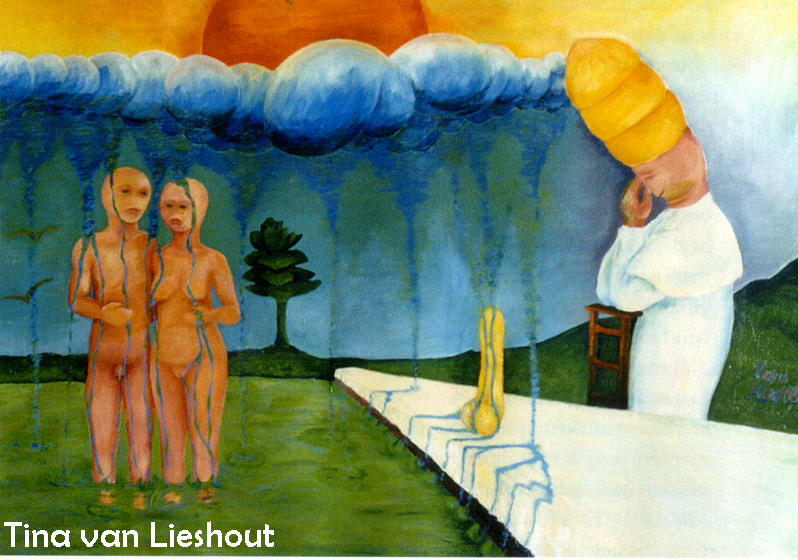
Tina meditation phallus worship

phallus worship

NEW WOMAN – ME!  no 17

every time again confused spirals of thought
from a complacent church leadership
collide ferociously against my indignant soul
deeming themselves infallible and showing no scruples
this leadership announces God’s predilection for the male
for a male ‘God – He – has created like himself’

my fantasy and my feeling of wounded self-respect created an image
— in analogy to the biblical golden calf —
of the pope devoutly kneeling before the gilded phallus

as counter pole I see my own experience of God
it rehabilitates my relationship to ‘God–with-us’
in creative freedom I picture to myself from biblical texts
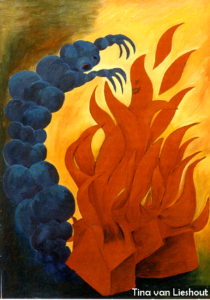
how God shows Herself present
hidden in plain day light
as a column of cloud
as a column of fire in the darkness of night

© Tina van Lieshout
translation John Wijngaards

MEDITATIONS

  • the face of time

  • I accuse woman

  • past present future

  • phallus worship

  • my dream

Tina van Lieshout was a Dutch Catholic woman who felt called to the priesthood. Her diocese refused her admission to the priestly formation programme which she challenged in a high-profile court case. She lost. Being both a gifted artist and poet, she described her despair in a series of paintings and meditations. But she also expressed through them her determination to realise her potential as a free and equal person  Her work was published in the Dutch book Ook in de Naam van de Moeder en de Dochter [= ‘Also in the Name of the Mother and the Daughter’], Wilco, Amersfoort 2000. She died in 2010.

Jesus Christ wants women to be priests

Jesus Christ wants women in the priesthood. Proclaim it!

SEVEN STRATEGIES TO PROMOTE WOMEN’S ORDINATION, no 7


Jesus Christ revealed to us that God is Love. He came to restore full human dignity by offering all of us, both men and women, to become children of God. He established a new realm on earth: the Kingdom of God in which the overriding values of mercy and justice would rule supreme. He called on all of us to proclaim the Good News that this new era had begun. Last not least, he wanted and wants all citizens of that new ‘realm of love’ to be able to share fully in his own prophetic, royal and priestly roles. All this implies that, in our time when patriarchal prejudices are being unmasked, Christ wants women as much as men to be able to minister as priests.

Rome maintains that the exclusion of women from holy orders is based on an irrevocable decision by Jesus himself. But is this really true? Yes, all the twelve apostles were men, but did Christ intend to exclude women for all time to come? He certainly did not!

How can we know what Christ wanted?

When someone is still alive, it is easy. We can ask him or her to explain what precisely he or she has in mind. After a person has died it becomes much more difficult. Sometimes we can determine their mind by uncovering explicit or implicit decisions in the person’s own life. At times we only have pointers. Let me illustrate the problem and possibilities in a fictitious human example.
Imagine Marcel Dubois being a wealthy French merchant living in Marseille. Through contacts in the French colonies he got to know about leprosy. Being a philanthropist he decided, let us say, in 1876 to establish the Marcel Dubois Leprosy Fund. Marcel invested millions of his own money in the fund. He laid down that the income of the fund should specifically be used to provide medical support to lepers. After he died, administering the fund was delegated to a board of trustees.
In the course of time the trustees faced problems. They were asked to support a political campaign to make the eradication of leprosy a top priority in Sri Lanka. They turned the request down because the founder had explicitly rejected any political involvement.
Also, it was discovered that apart from the provision of medical aid, there was a need to offer psychological care to family members of lepers. The question was raised: can the Marcel Dubois Leprosy Fund finance such care given the fact that the founder had allocated the money for medical purposes? The trustees examined the question at length. They found that Marcel, while still alive, had given a grant from the fund to a mother who was looking after her leprous child. They came to the conclusion that in giving this, Marcel himself had already implicitly decided the validity of grants for psychological care in the context of leprosy.
Through a better understanding of how the infection can be prevented, leprosy was beginning to be eradicated worldwide. The leprosy fund was building up a surplus. The question that arose was: could the fund support medical relief for other diseases, let us say AIDS? The trustees found no implicit decisions on this in Marcel Dubois’ actions, but they discovered pointers that seemed to indicate his consent.
How does this apply to the question of determining ‘the mind of Jesus’ on the ordination of women? Like in the fictitious example discussed above we should explore a number of questions:
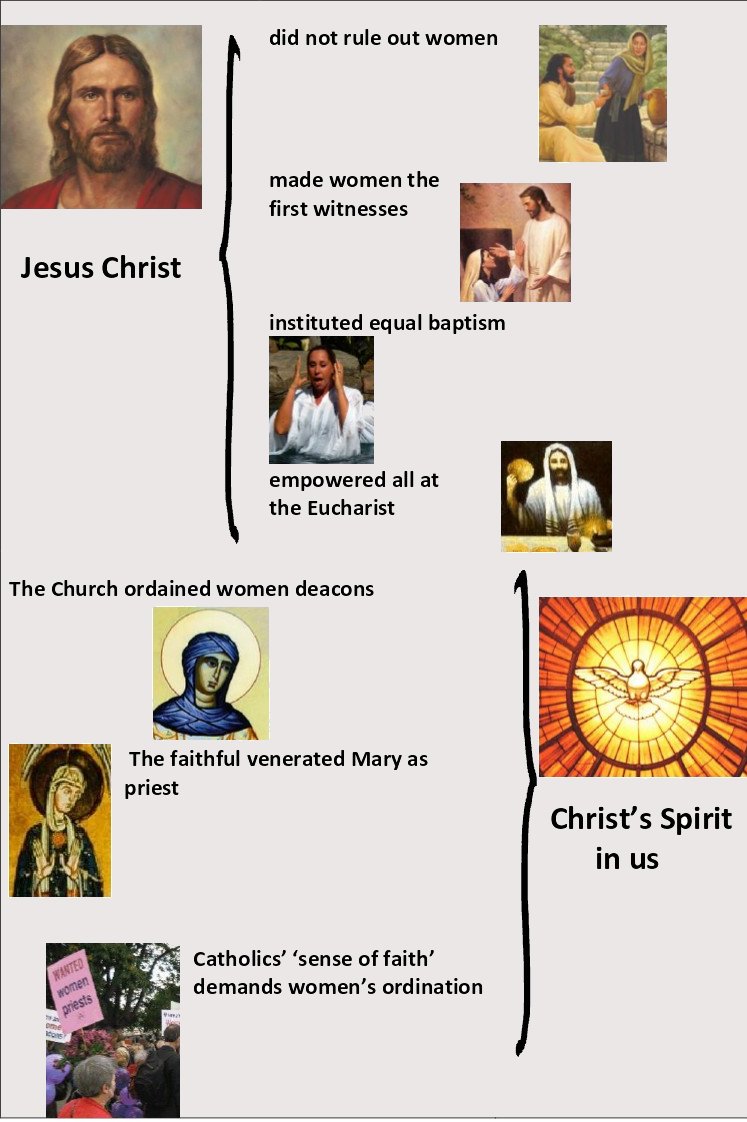
· Did Jesus at any time explicitly rule out women’s taking part in the ordained ministries? I prove that the answer is a categorical NO.
· Are there pointers in his life that show Jesus would have been open to women ministering as priests? I give abundant evidence in the book of Jesus’ extraordinary respect for, and openness to, women.
· Did Jesus take implicit decisions that show he wanted women to be included in the ministry? Yes, he did. He established a rite of initiation, the sacrament of baptism, that is the same for men and for women. And women were there at the Last Supper when he commissioned all his disciples including women: “Do this in memory of me!”
· Last not least, can we determine Christ’s mind for the Church today, what he wants in our own time? Yes, we can.

Christ’s Spirit in us makes known what Christ wants

Jesus was not just a human founder. He poured his own Spirit into us. He promised that in future eras to come that Spirit would reveal his mind to us.

“I still have many things to say to you
but they would be too much for you now.
When the Spirit of Truth comes
she will lead you to the fulness of truth,
since she will not be speaking as from herself
but will say only what she has learnt
[from me].
She will explain to you
things that lie in the future.” (
John 16,12-14)

So what can we learn from Christ’s Spirit in the Church about women’s ministries?

To begin with, during the first thousand years of its existence, the Church did impart the sacramental diaconate to women. And the diaconate is one of the three sacred ministries which the Council of Trent declared to be the one sacrament of Holy Orders which also include the priesthood and the episcopacy. In other words: if they could be ordained deacons, they can also be ordained priests. Holy Orders are not reserved to men alone.

Then, throughout the centuries theologians, church leaders and the ordinary faithful venerated Mary as Priest. They believed that Mary had full part in Jesus’ priesthood. And since Mary too is a woman, the implicitly affirmed that also women can be priests.

Last not least, in our own time, with all the ancient social prejudices against women having been exposed, the vast majority of educated Catholics all over the world are convinced women too can and should be ordained priests. It manifests their ‘sense of faith’. It is the Spirit of Christ speaking – a voice that may not be ignored.

The conclusion is clear: Christ wants women too to have access to all three Holy Orders. If so, this is the central truth we should proclaim when promoting women’s ordination. He is the founder of Christianity. He established the realities that underlie Christian worship. He appointed the spiritual leaders, whom we now call ‘priests’. He wants both men and women to be among them.

John Wijngaards

SEVEN STRATEGIES TO PROMOTE WOMEN’S ORDINATION

  1. Recognise that the SOURCE for women’s openness to ordination lies not in emancipation but in baptism.
  2. Understand Rome’s arguments for its ban on women priests and know how to refute them.
  3. Be familiar with the theological reasons for ordaining women.
  4. Create opportunities to educate people for change.
  5. Make women visible in church.
  6. Support integrity in the Church and voices of protest.
  7. Jesus Christs wants also women in the priesthood, not just men. Proclaim it!

John Wijngaards, WHAT THEY DON’T TEACH YOU IN CATHOLIC COLLEGE. Women in the priesthood and the mind of Christ, Acadian House Publishing, Lafayette USA 2020.

lgbt-statement-german

Deutsch Nederlands English Italiano Polska Español


In preparation

Femmes diacres : une autre « solution » vaticane ?

Femmes diacres : une autre « solution » vaticane ?

Communiqué de presse pour diffusion immédiate: Mercredi 8 Avril – English version here.

Cette dernière annonce d’une commission d’étude sur les femmes diacres a toutes les caractéristiques d’un «emploi à l’interne».

Plutôt que de sélectionner les membres de la Commission parmi les associations théologiques catholiques du monde entier, le Vatican a nommé dix initiés; pas un seul d’entre eux n’a jamais déclaré avoir souhaité, et encore moins approuvé, l’ordination des femmes au diaconat.

En effet, la plupart des membres ont déjà travaillé avec le Vatican et sont donc connus pour leur adhésion à la « ligne de parti » actuelle qui nie que les femmes aient été des ministres égales dans l’église primitive et qui tolère les restrictions qui leur sont imposées.

Mais une question aussi litigieuse exige une expertise indépendante et évaluée par des pairs, et non par des théologiens de la cour, comme l’a publiquement demandé l’Institut Wijngaards en février. Tant que le processus de sélection de ces commissions d’étude papales n’aura pas été rendu public, transparent et ouvert, il y a peu d’espoir que le passé éclaire le présent ou que la vérité prévale.

L’ancienne commission d’étude papale, qui a travaillé de 2016 à 2019, avait au moins inclus deux théologiens connus pour leur soutien aux femmes diacres et pourtant leur rapport final a été gardé secret et n’a jamais été rendu public. Qu’ont-ils discuté qui a été enterré dans les archives et pourquoi doit-on recommencer maintenant l’étude des femmes diacres?

Les propres recherches de l’Institut Wijngaards montrent que des milliers de femmes ont servi comme diacres ordonnées pendant le premier millénaire de l’Église et ont reçu une ordination « sacramentelle » complète. Notre « Appel documenté pour la réintégration des femmes diacres » a été signé par des théologiens de premier plan, vingt organisations catholiques et d’éminents catholiques du monde entier.

Nous condamnons la décision de choisir un groupe d’universitaires pour décider de ce qui ne peut être qu’une évidence. Nous sommes susceptibles de les voir appeler à un nouveau rôle restreint qui vise à pacifier ceux qui réclament un semblant d’égalité pour les femmes, mais qui fera simplement en sorte qu’il reste des citoyens de seconde classe. Aujourd’hui est un jour triste tant pour l’Église catholique romaine que pour l’ouverture si souvent encouragée par le pape François.”

Traduction libre par Pauline Jacob, du Réseau Femmes et Ministères

Media Advisory: We put together here our research notes on the relevant expertise of the new members of the papal commission on women deacons (April 2020 edition). Despite concerns that many of them appear to already have made their minds up against the possibility of a sacramental ordination of women to the diaconate, we know that true scholars are always ready to re-examine the evidence, and we hope this will be done by them – The research Team at the Wijngaards Institute.

Members of Papal Commission on Women Deacons

Media Advisory: Below are our few notes on the relevant expertise of the new members of the papal commission on women deacons (April 2020 edition). Despite concerns that many of them appear to already have made their minds up against the possibility of a sacramental ordination of women to the diaconate, we know that true scholars are always ready to re-examine the evidence, and we hope this will be done by them – The research Team at the Wijngaards Institute

Prof. Manfred Hauke: Staunch opponent of women deacons. He is repeatedly on record as having said women were never sacramentally ordained as deacons, and cannot be ordained. See his book Das Weihesakrament für die Frau – eine Forderung der Zeit? Zehn Jahre nach der päpstlichen Erklärung „Ordinatio sacerdotalis“. Verlag Franz Schmitt, Siegburg 2004, ISBN 3-87710-281-6, and in English: Women in the Priesthood? A Systematic Analysis in the Light of the Order of Creation and Redemption (San Francisco: Ignatius Press, 1988). Also e.g. his interview here: https://www.catholicnewsagency.com/news/theologian-dismisses-call-for-women-deacons

Dr. Caroline Farey: Diocesan Mission Catechist for the Diocese of Shrewsbury, UK. Conservative theologian whose research profile is minimal and which does not include any academic publication about women deacons or women’s ordination. Until 2019 she taught at a small, very conservative theological institution in the UK, the School of Annunciation, which provided distance-learning theology courses but closed that year due to a lack of funding.

Prof. Barbara Hallensleben: Current member of the Vatican’s “International Theological Commission”, and consultor to the Vatican’s Pontifical Council for Promoting Christian Unity. In 2016 she participated in a symposium on women organised by the CDF. She supports the Vatican line on women.

Prof. Catherine Brown Tkacz: in 2013 she published an article arguing that the ancient ordination of women deacons was not the same (i.e. it was inferior/not sacramental) as the ordination of male deacons. In other words: women have never received sacramental ordination. See “Deaconesses and the Spiritual Equality of Women”, Revue d’histoire ecclésiastique 108, 1 (2013), pp. 5-44.

Significantly, this is the exact opposite of what was affirmed by two of the members of the previous papal commission, Phyllis Zagano and Bernard Pottier SJ, both of whom acknowledged that women had not just been ordained as deacons, but that their ordination was sacramental.

Prof. Dominic Cerrato: married lay permanent deacon, in 2014 he wrote the book In the Person of Christ the Servant: A Theology of the Diaconate Based on the Personalist Thought of Pope John Paul II without discussing women deacons. His book bears the endorsement of Dr James Keating, another permanent deacon and now also a member of this commission. In turn, Dr Cerrato contributed an essay to Keating’s 2017 edited book on deacons.

Prof. James Keating: edited the collection of essays The Character of the Deacon: Spiritual and Pastoral Foundations, published in 2017; one of the contributions is by Dr Cerrato. Throughout the entire volume, there is not a single mention of women deacons. Dr Keating endorsed Dr Cerrato’s 2014 book on deacons, which likewise is silent on the female diaconate.

Prof. Santiago del Cura Elena: Past member of the Vatican’s “International Theological Commission” and one of the authors of that commission’s famously inconclusive 2002 document “From the Diakonia of Christ to the Diakonia of the Apostles”. In 2017 he published a lengthy essay on the general topic of the diaconate, “Cuestiones pendientes en la teología actual del diaconado: comentario y valoración,” Burgense: Collectanea Scientifica, ISSN 0521-8195, Vol. 58, no. 1, 2017, pp. 11-71; as well as “Estado actual de la cuestión relativa al diacon(is)ado de las mujeres”, Revista CONFER, Vol. 56, no. 215 (July-August-September 2017), pp 381-400, available at http://confer.es/82/activos/texto/6589-confer-56_215–julio-septiembre2017-.pdf .

Prof. Anne Marie Pelletier: on record as defending Ordinatio Sacerdotalis (1994) and arguing only men can be priests, see e.g. her 1995 article “Masculin, féminin: le sens d’une tradition. À l’occasion du débat sur l’ordination des femmes”, Nouvelle Revue Théologique 117, 2 (1995), pp. 199-216. However, more recently she admitted having changed her mind somewhat. Her consistent emphasis over the past few years has been on the need to reform the ministerial priesthood: “There is a need to review the identity of the ministry of the priest, and to remove the sacralisation which, to my mind, is more pagan than evangelical.” She has long insisted on the need to go back to the fundamental equality of Christians through baptism and the common priesthood. From that perspective, “to think of [the female priesthood] as a solution belies, to my mind, a clerical mindset. It would ratify the idea of a ministerial priesthood which would be a promotion, an elevation. Which it isn’t.”

And on the female diaconate in particular, she added: “As for diaconal ordination [of women], we hope that the past is not simply norm of the present. Fidelity to tradition is also to innovate, starting from the same confession of faith.”

She was awarded the “Ratzinger Prize” in 2014.

Theologians reject Pope’s vision of women’s role and demand unbiased committee examine evidence of Women Deacons

Theologians reject Pope’s vision of women’s role and demand unbiased committee examine evidence of Women Deacons

Immediate release: Wednesday, February 12th

The Wijngaards Institute for Catholic Research laments the announcement today that the papal ban on women deacons will remain in place. The Pope’s refusal to consider the ordination of women rejects the explicit recommendation of the synod on the Amazon, where about 185 bishops recognised the reality on the ground that “the majority of Catholic communities are led by women” and that “in a large number of these consultations, the permanent diaconate for women was requested”.

Pope Francis justified such a unilateral decision on the grounds that he does not want “to clericalise women.” This is a dereliction of his duty as a leader with the power to make positive change and challenge discrimination and his position cannot be justified unless and until the Pope also declares that no more men should be recruited for the ministry so as not to “clericalise” them. This post-synodal document is a betrayal of women by denying them the grace of holy orders to do a ministry they are already carrying out. Moreover, women have been ordained deacons in the past.

The Wijngaards Institute’s own research, conducted over the past 30 years, shows that tens of thousands of women served as ordained deacons during the first millennium of the Church and received a full ‘sacramental’ ordination, in today’s theological language. Our documented appeal for the reinstatement of women deacons, published in September 2015, was signed by leading theologians and prominent Catholics from around the world. It was also sent to Pope Francis and his office acknowledged receiving it: Wijngaards Institute on the reinstatement of women deacons.

We are calling on Pope Francis to read this evidence and to establish a new commission that is comprised of truly independent scholars recommended by international Catholic theological associations*. We caution against allowing the Curia to handpick a group of academics known for their traditional views and hostility to women to decide on a new, restricted role for women that ensures they remain second class citizens.

The post-synodal document means that thousands of women, among them many women religious, will now continue to do the work to sustain the Church behind the scenes, still lacking official recognition, still denied the authority to act without the supervision of men.

Pope Francis’ decision perpetuates gender discrimination that denies women the dignity and respect to live out their vocations and be recognised as critical to the equal leadership of Church communities as the peers of, not servants of men.

Contact:

Miriam Duignan: T +44 7970 926910 E miriam.duignan@wijngaardsinstitute.com

Dr. Luca Badini Confalonieri: T: + 44 7446 283699 E luca.badini@wijngaardsinstitute.com

  • Suggested associations asked to delegate experts include: The European Society for Catholic Theology; The Catholic Theological Association of America; Red Latinoamercana de Informacion Teologica, Catholic Hispanic Theologians; Asociacion de Teologas; The Theological Ecclesia of Women in Asia

Réécrire les évangiles: l’argument du Cardinal Ladaria contre l’ordination des Femmes

Réécrire les évangiles: l’argument du Cardinal Ladaria contre l’ordination des Femmes


On vous pardonnerait de penser que diriger la Congrégation pour la Doctrine de la Foi (CDF) exige une connaissance approfondie de la théologie. Et pourtant, cela ne semble pas être le cas actuellement. Dans une interview récente, le chef de la CDF, l’archevêque Luis Ladaria SJ, a fait une série d’affirmations qui sont sans fondement ou carrément erronées. “Le Christ a voulu conférer ce sacrement aux douze apôtres, tous des hommes, qui à leur tour l’ont transmis à d’autres hommes”, a déclaré le jésuite espagnol.

Il serait difficile d’intégrer davantage d’affirmations erronées dans une phrase si courte. Jésus a-t-il “ordonné” les Douze? Il ne l’a pas fait. Les Douze ont-ils «ordonné» des successeurs? Ils ne l’ont pas été. Les Douze étaient-ils le modèle original d’un ministère institutionnellement ordonné? Encore une fois, ils ne l’étaient pas.

Au lieu de cela, le Nouveau Testament (NT) témoigne d’une variété de fonctions, de ministères et d’arrangements institutionnels (prédicateurs itinérants, enseignants et apôtres, diacres, [conseils d’anciens], patrons de maison, etc.), dont beaucoup sinon tous étaient ouverts aux femmes à remplir (y compris celui de “diacre” et d'”apôtre”!).

Enfin, Ladaria saute sur l’hypothèse tacite et erronée que les Douze étaient le modèle original et exclusif du ministère «ordonné» à la conclusion tout aussi erronée que leur «masculinité» était essentielle à la «substance» même dudit ministère. Encore une fois, c’est tout à fait sans fondement: Ladaria aurait tout aussi bien pu argumenter que seuls les hommes juifs circoncis pouvaient être ordonnés ministres.

Ce que des déclarations similaires du Vatican passent sous silence c’est que le NT mentionne de nombreuses femmes comme d’éminentes disciples (Marie-Madeleine étant peut-être la première) et des ministres importantes dans l’église primitive. À la fin de sa lettre aux Romains, Paul salue un certain nombre de femmes, qu’il désigne par un titre: Junia, une «apôtre exceptionnelle» (!); Priscilla, une «collaboratrice dans le Christ» (un terme que Paul utilise comme synonyme de «apôtre»), ainsi que Marie, Tryphène, Tryphose et Persis, de qui on a dit qu’elles «ont travaillé très dur dans le Seigneur”.

Quelques lignes plus tôt, Paul accueille Phébée, une «diacre»; et en 1 Tim, 3-11, il y a même une liste d’exigences de traits de caractère pour les femmes diacres (parfois incorrectement traduit comme “épouses d’ [hommes] diacres”). Comme nous le savons d’ailleurs dans le NT, les «diacres» remplissaient des fonctions importantes et de haut niveau telles que la prédication, l’enseignement, ainsi que la distribution d’aumônes et de nourriture pendant les repas communs.

“Il n’y a ni Juif ni Gentil, ni esclave ni libre, ni mâle ni femelle, car vous êtes tous un en Jésus-Christ” (Ga 3, 28): c’est l’un des passages les plus profonds et les plus révolutionnaires de Paul et il est extrêmement regrettable que 2000 ans plus tard il soit encore contredit dans la pratique au sein de l’Église catholique, en raison d’une position idéologique fondée sur d’anciens préjugés misogynes, contraires à la preuve du NT et sourde au message libérateur de Jésus.”

Traduit par le “Réseau Femmes et Ministères”, Facebook Page: https://www.facebook.com/femmesministeres/

Re-writing the Gospels: Cardinal Ladaria’s Argument against Ordaining Women

Re-writing the Gospels: Cardinal Ladaria’s Argument against Ordaining Women

You would be forgiven for thinking that leading the Congregation for the Doctrine of the Faith (CDF) requires a thorough knowledge of theology. And yet that does not appear to be currently the case. In a recent interview, the head of the CDF, Archbishop Luis Ladaria SJ, made a series of affirmations that are either groundless or outright mistaken. “Christ wanted to confer this sacrament [i.e. Holy Order] to the Twelve apostles, all men, who in turn passed it on to other men,” the Spanish Jesuit stated.

It would be hard to pack more mistaken affirmations in such a short sentence. Did Jesus “ordain” the Twelve? He didn’t. Did the Twelve “ordain” successors? They didn’t. Were the Twelve the original model for an institutional ordained ministry? Again, they were not.

Instead, the New Testament (NT) witnesses to a variety of functions, ministries, and institutional arrangements (itinerant preachers, teachers, and apostles; deacons; [councils of] elders; house patrons; etc.) are mentioned, many if not all of which were open to women to fill (including “deacon” and “apostle”!).

Finally, Ladaria jumps from the tacit, erroneous assumption that the Twelve were the original and exclusive model of “ordained” ministry to the equally mistaken conclusion that their “maleness” was essential to the very “substance” of said ministry. Again, this is entirely baseless: Ladaria might as well have argued that only circumcised Jewish men can be ordained ministers.

What similar statements from the Vatican routinely pass under silence is that the NT mentions many women as prominent disciples (Mary Magdalene being perhaps the foremost) and important ministers in the primitive church. At the end of his letter to the Romans, Paul greets a number of women, some of whom he designates by title: Junia, an “outstanding apostle” (!); Priscilla, a “co-worker in Christ” (a term Paul uses as a synonym of “apostle”), as well as Mary, Tryphena, Tryphosa, and Persis, all of whom are said to “have worked very hard in the Lord.”

Few lines earlier Paul greets Phoebe, a “deacon”; and 1 Tim 3:11 even has a list of character requirements for women deacons (at times mistakenly translated as “[male] deacons’ wives”). As we know from elsewhere in the NT, “deacons” fulfilled important and high-profile functions such as preaching, teaching, as well as distributing alms and food during the common meals.

“There is neither Jew nor Gentile, neither slave nor free, nor is there male and female, for you are all one in Christ Jesus” (Gal 3:28): this is one of Paul’s most profound and revolutionary passages, and it is immensely regrettable that 2,000 years on it is still contradicted in practice within the Catholic Church, due to an ideological position based on ancient misogynistic prejudices, contrary to the NT evidence and deaf to Jesus’ liberating message.

When the Magisterium Ignores Theology

When the Magisterium Ignores Theology

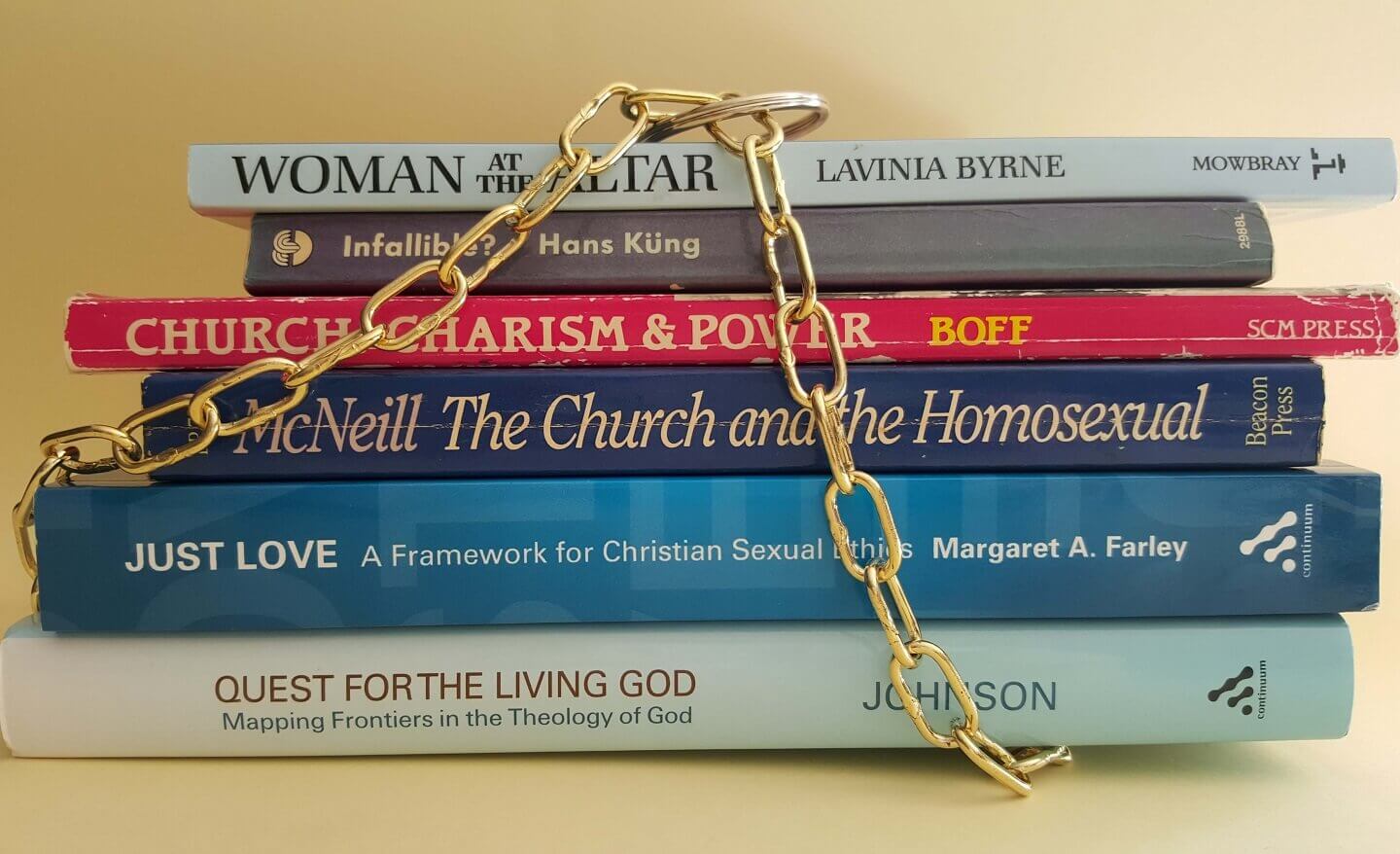
Some of the ground-breaking theology books banned or otherwise censored by the Catholic hierarchy since Vatican II.

In April 1976 the Pontifical Biblical Commission concluded unanimously: “It does not seem that the New Testament by itself alone will permit us to settle in a clear way and once and for all the problem of the possible accession of women to the presbyterate.” In further deliberation, the commission voted 12-5 in favour of the view that Scripture alone does not exclude the ordination of women, and 12-5 in favour of the view that the church could ordain women to the priesthood without going against Christ’s original intentions.

As is well known, this was ignored by the Congregation for the Doctrine of the Faith (aka CDF), which promulgated few months later the infamous document “Inter Insigniores – On the Question of Admission of Women to the Ministerial Priesthood,” arguing that “the Church” (sic: they are referring to the episcopal hierarchy, i.e. themselves), cannot ordain women to the priesthood.

People may not know it, but something similar – indeed even worse – happened with regard to the question of women deacons. That is, the original study commissioned to the International Theological Commission by Paul VI on the subject was suppressed, and never officially published. No surprise there: the evidence that women deacons were indeed ordained – and in a way understood to be identical to that of their male counterparts – for more than a thousand years is both abundant and incontrovertible. But successive Popes have apparently found that very difficult to accept.

Interestingly, most observers believe that the suppressed study was later published as an article in Orientalia Christiana Periodica in 1974 by Cipriano Vagaggini. Vagaggini was then member of the International Theological Commission to which Paul VI had commissioned the study, and while no radical, that article makes it clear that he was a conscientious scholar: the amount of evidence assessed in it is truly remarkable. Its conclusion was that the ordination of women deacons for more than a thousand years was as sacramental as that of their male colleagues. Below I quote one of the final paragraphs of the study:

If one accepts what has been said thus far, one must also acknowledge the following conclusion: theologically, in virtue of the use of the Byzantine Church, it appears that women can receive diaconal ordination, which, by nature and dignity, is equated to the ordination of the deacons, and not simply to that of the subdeacons or lectors, and much less, to use the terminology of today, to that of some lesser ministry constituted by what today one would call a simple benediction.

A similar dismissal of uncomfortable theological findings had happened before, with regard to the Humanae Vitae affair on contraception: the Pope first established his own commission of experts, the famed “Pontifical Commission on Birth Control,” only to completely disregard its findings on the basis that they would have required them to admit that their predecessors had been wrong.

So it is important to notice that what’s happened repeatedly since Vatican II: namely, that while the principle was accepted in theory that doctrinal statements need to be based on the relevant (exegetical, theological, etc) evidence/expertise, such a principle has in fact been disregarded whenever the findings run counter to ingrained beliefs and opinions of the hierarchy – and the more so when such findings would threaten the current power-structure of the church, as the admission of women to the ordained ministry would do.

But as Father Thomas Reese SJ has been fond of repeating, any multinational in which the CEOs routinely ignore, or are in no speaking terms with, the R&D department is doomed to perform very poorly indeed. QED.

The Prohibition Against Ordaining Women: On Not Inventing Doctrine

The Prohibition Against Ordaining Women: On Not Inventing Doctrine

While flying home to Rome on Tuesday 1st November, Pope Francis re-affirmed the Catholic Church’s refusal to ordain women. He noted the matter was clearly decided under Pope John Paul II, who rejected the idea of women priests in 1994. The Vatican says this teaching is an infallible element of Catholic tradition because it has been taught by the so-called “ordinary and universal magisterium.” This refers to the constant teaching of the bishops (including the Pope) throughout the history of Christianity. Such a constant teaching, according to the Second Vatican Council (“Lumen Gentium – Dogmatic Constitution on the Church,” §25), is a mark of infallibility.

However, Ordinatio Sacerdotalis does not fulfil the criteria for being an expression of such an “ordinary and universal magisterium.” Moreover, as theologian Nicholas Lash noted, by claiming that it is indeed such an expression and that the discussion is over, it has been “a scandalous abuse of power.” It is worth recalling in this connection two fine articles explaining the points above:

• Nicholas Lash, “On Not Inventing Doctrine,” The Tablet, 2 December 1995, p. 1544;

• Peter Burns, S.J., “Was The Teaching Infallible?”, BASIC Newsletter, Supplement Feb. 1997, pp. 1-12 (both links open on our website www.womenpriests.org).

Now, the papacy and the CDF have always responded to criticism of the ban on women by pointing out that Jesus only chose men as members of the Twelve. But the Twelve 1) were a group distinct from, and smaller than, the larger group of “apostles”; 2) their primary distinctive function was merely symbolic, i.e. their number evoked the twelve founding tribes of the people of Israel, so as to underline that Jesus was effectively founding a “new Israel”, i.e. the entire community of his disciples, men and women; 3) crucially, they cannot be regarded as the original church ministers, and so as a model for all future such ministers, for two key reasons: 4) they were not replaced after their death (with the exception of Judas Iscariot, as a one-off), and so did not have successors; 5) they did not seem to have had any official position in the earliest church (James the brother of the Lord, rather than Peter, was clearly head of the nascent Jerusalem church, according to the Acts of the Apostles).

In summary, the Twelve’s function was primarily symbolic, as representatives of the new Israel (i.e. the entire community of the church), and not of a supposedly male-only, patriarchal clerical caste. Last but not least, the group of the “apostles” was a larger group than the Twelve alone, and it included women: a certain Junia is explicitly mentioned by Paul in Romans 16:1 as “outstanding among the apostles.” Interestingly, the name Junia had long been changed by translators to its masculine form, “Junias”, because it was deemed impossible that Paul had called a woman “apostle.” But New Testament scholars have now re-established definitely the feminine gender of the name, and so the marvellous evidence of a prominent female leader of the nascent church has been restored.

Most of what’s in the paragraph above is explained at length in the rather wonkish but wonderfully written famous response by renowned New Testament scholar Elizabeth Schussler Fiorenza to Ordinatio Sacerdotalis, entitled simply “The Twelve” (link opens the full text on our website www.womenpriests.org).
Finally, consider this: “All who are baptised in Christ, have put on Christ. There is no longer any discrimination between Jew and non-Jew, slave and free, male and female” (Galatians 3:28). Thus every baptised woman shares fully in Christ’s priesthood, kingship and prophetic mission. Baptism implies a fundamental openness to all the sacraments, including the ordained ministry. More in our FAQs on infallibility on this page on our website www.womenpriests.org.

Conclusion: there are no valid arguments against the ministerial ordination of women, and many truly Catholic arguments in favour!