
Be familiar with the theological reasons for ordaining women
SEVEN STRATEGIES TO PROMOTE WOMEN’S ORDINATION, no 3

Study the reasons for ordaining women springing from our Christian faith. This is necessary if you want to make other people understand why it is right that women too share in the ordained ministry of the priesthood. The reasons lie embedded in Sacred Scripture, in our Christian Tradition, in ancient Church practice and in reflections on the implications of our core beliefs.
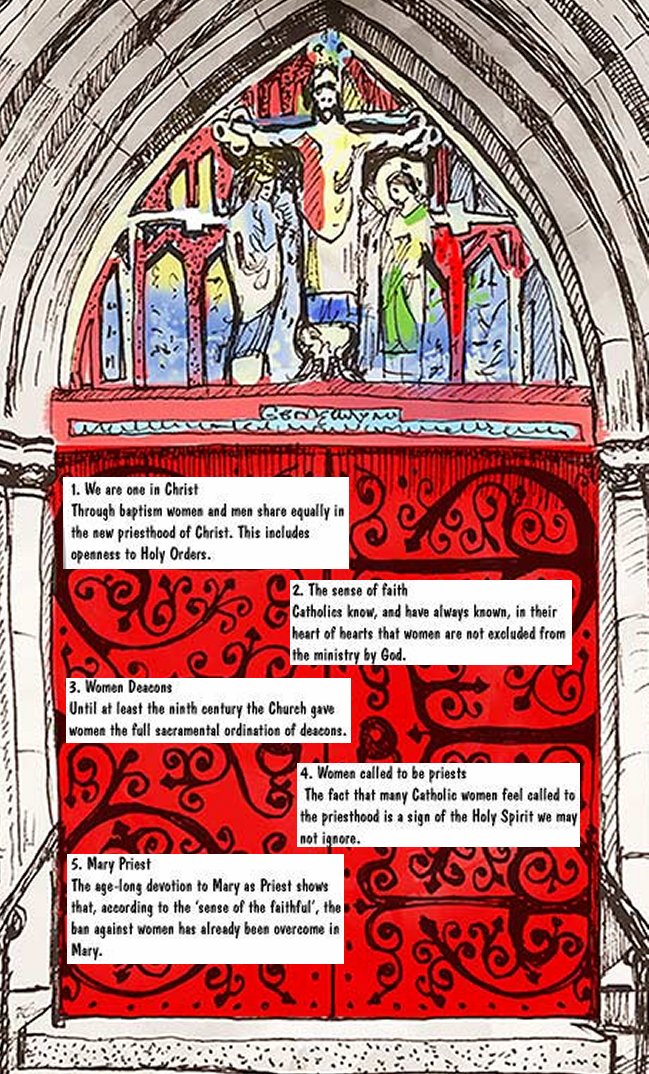
Did Christ want women to be priests?
When someone is still alive, it is easy. We can ask him or her to explain what precisely he or she has in mind. After a person has died it becomes much more difficult. Sometimes we can determine their mind by uncovering explicit or implicit decisions in the person’s own life. At times we only have pointers. Let me illustrate the problem and possibilities in a fictitious human example.
Imagine Marcel Dubois being a wealthy French merchant living in Marseille. Through contacts in the French colonies he got to know about leprosy. Being a philanthropist he decided, let us say, in 1876 to establish the Marcel Dubois Leprosy Fund. Marcel invested millions of his own money in the fund. He laid down that the income of the fund should specifically be used to provide medical support to lepers. After he died, administering the fund was delegated to a board of trustees.
In the course of time the trustees faced problems. They were asked to support a political campaign to make the eradication of leprosy a top priority in Sri Lanka. They turned the request down because the founder had explicitly rejected any political involvement.
Also, it was discovered that apart from the provision of medical aid, there was a need to offer psychological care to family members of lepers. The question was raised: can the Marcel Dubois Leprosy Fund finance such care given the fact that the founder had allocated the money for medical purposes? The trustees examined the question at length. They found that Marcel, while still alive, had given a grant from the fund to a mother who was looking after her leprous child. They came to the conclusion that in giving this, Marcel himself had already implicitly decided the validity of grants for psychological care in the context of leprosy.
Through a better understanding of how the infection can be prevented, leprosy was beginning to be eradicated worldwide. The leprosy fund was building up a surplus. The question that arose was: could the fund support medical relief for other diseases, let us say AIDS? The trustees found no implicit decisions on this in Marcel Dubois’ actions, but they discovered pointers that seemed to indicate his consent.
How does this apply to the question of determining ‘the mind of Jesus’ on the ordination of women? Like in the fictitious example discussed above we should explore a number of questions:
• Did Jesus at any time explicitly rule out women’s taking part in the ordained ministries? We can prove that the answer is a categorical NO.
• Are there pointers in his life that show Jesus would have been open to women ministering as priests? We have abundant evidence of Jesus’ extraordinary respect for, and openness to, women.
• Did Jesus take implicit decisions that show he wanted women to be included in the ministry? Yes, he did. He established a rite of initiation, the sacrament of baptism, which is identical for men and for women. And women were there at the Last Supper when he commissioned all his disciples, bot women and men: “Do this in memory of me!”
Last not least, can we determine Christ’s mind for the Church today, what he wants in our own time? Yes, we can. Jesus was not just a human founder. He poured his own Spirit into us. He promised that in future eras to come that Spirit would reveal his mind to us.
John Wijngaards
SEVEN STRATEGIES TO PROMOTE WOMEN’S ORDINATION

- Recognise that the SOURCE for women’s openness to ordination lies not in emancipation but in baptism.
- Understand Rome’s arguments for its ban on women priests and know how to refute them.
- Be familiar with the theological reasons for ordaining women.
- Create opportunities to educate people for change.
- Make women visible in church.
- Support integrity in the Church and voices of protest.
- Jesus Christs wants also women in the priesthood, not just men. Proclaim it!