
Recognise that the SOURCE for women’s openness to ordination lies not in emancipation but in baptism
SEVEN STRATEGIES TO PROMOTE WOMEN’S ORDINATION, no 1

Opponents of women’s ordination usually claim that the desire for ordination arises from the contemporary drive for equal rights. They portray the demand for women priests as a modern and novel idea, a secular invention, the intrusion of profane social equality into the sacred precincts of the liturgy, a giving in to strident feminist bullying. Pope Paul VI’s Inter Insigniores blames both women’s emancipation and ecumenical pressure from other Churches. But while it is true that the climate of social emancipation has helped to raise the question of women’s absence from the ministries, the real origin of the demand lies in our common baptism.
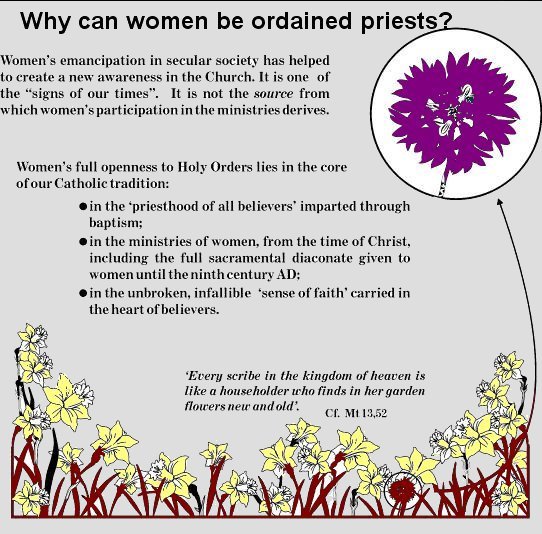
Since Vatican II women theologians have brought a new dimension to the Church. They began to systemically expose the inequality between men and women in all areas of Catholic life: in worship and spirituality, in the parish and in the home, in theology as well as in law. They re-examined the roles of women in the early Church and drew consequences from this for New Testament exegesis. They studied in detail women’s lives during various periods of the Church’s history. They brought new light, from a woman’s perspective, on matters of liturgical language, imagery and church symbolism. But none of these women theologians, to my knowledge, claimed that the equality of women in Christ derives from secular or civil rights. We have to carefully distinguish between external impulses on a doctrine and its Christian source.
The Second Vatican Council recognised that the Church should pay attention to what modern society is telling us. We should listen to the signs of our times. We are told to “decipher the authentic signs of God’s presence and purpose in the happenings, needs and desires which Christians share with other people of our age”. The Council endorsed present-day society’s concern for equal rights and it singled out the emancipation of women as an important issue. “For in truth”, the Council declared, “it must be regretted that fundamental personal rights are still not being universally honoured. Such is the case of women who are denied the right to choose a husband freely, to embrace a state of life or to acquire an education or cultural benefits equal to those available to men.” Now it is a fact that the rise of women in society does put pressure on the Church. It forces Catholics to answer the question: “Why are women still denied the sacrament of ordination and access to power structures in the Church?” But these wholesome external promptings are not themselves the justification for demanding women’s ordination.
That demand comes from our common baptism in Christ. For there is nothing that distinguishes the baptism of a man from that of a woman. As Paul said: “All who are baptised in Christ have put on Christ himself. So there is no difference between men and women … You are all one in Christ Jesus” (Galatians 3, 26-28). Because we do not live any longer in Old Testament times, we do not realise how significant this fact is. The Israelites were God’s people, yes, but the men were more God’s people than the women. Men did not only dominate in the home and in society. Men enjoyed a privileged status in religion. Only the men were circumcised. The covenant was made directly with them. Women belonged to the covenant through their fathers and husbands. The men had to sacrifice in the Temple. The men read the Torah in the synagogues. Women could take part if they wished, but then from a distance. Christ overthrew this fundamental discrimination.
Both men and women equally die with Christ and rise with him to new life. Both men and women become members of his new covenant, and share in his eucharistic meal on an equal footing. Both men and women in like manner share in Christ’s priestly, prophetic and royal dignity. The openness of women to the ordained ministry arises from within the sacrament of baptism itself. The cry for social equality may have woken us up. The truth of equality in Christ’s covenant has always been there.
The demand for the ordination of women arises from the centre of our Catholic faith. Read more about baptism here.
John Wijngaards
SEVEN STRATEGIES TO PROMOTE WOMEN’S ORDINATION

- Recognise that the SOURCE for women’s openness to ordination lies not in emancipation but in baptism.
- Understand Rome’s arguments for its ban on women priests and know how to refute them.
- Be familiar with the theological reasons for ordaining women.
- Create opportunities to educate people for change.
- Make women visible in church.
- Support integrity in the Church and voices of protest.
- Jesus Christs wants also women in the priesthood, not just men. Proclaim it!