Home » Women's Ordination » Page 3

Category: Women’s Ordination

Make women more visible in church

Make women more visible in the Church

SEVEN STRATEGIES TO PROMOTE WOMEN’S ORDINATION, no 5


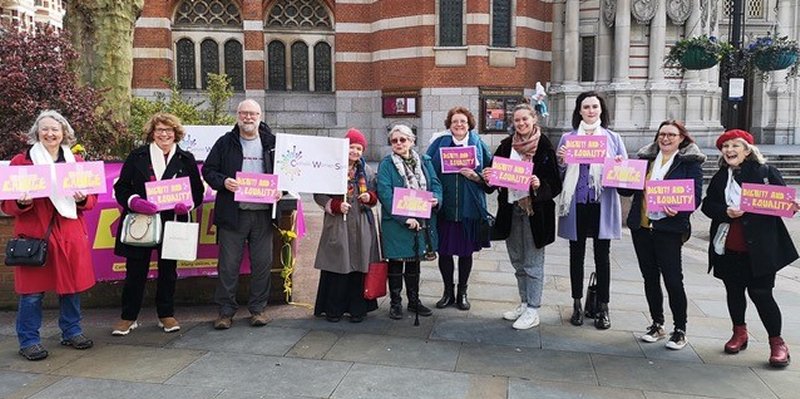
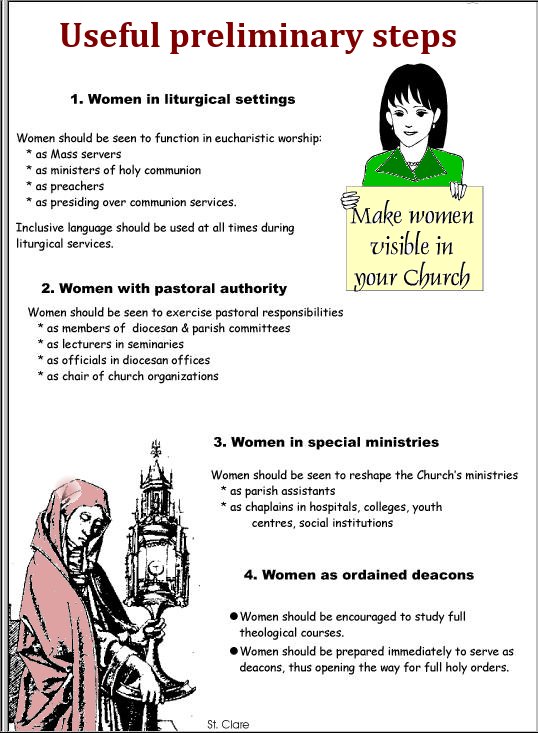
A lesson we can learn from psychology is that contrary experiences help to overcome prejudice. Familiarity is the key word here. Catholics are used to see only men officiating at the altar, only men taking all decisions in the diocese and the parish. Unconsciously they associate liturgical functions with men. The more they see women in roles that border on the priestly ministry, the more they will overcome inner psychological resistance. So, though they are not the final solution, intermediate steps too count. Psychological barriers can be broken down by women assuming a more visible presence in the Catholic community.

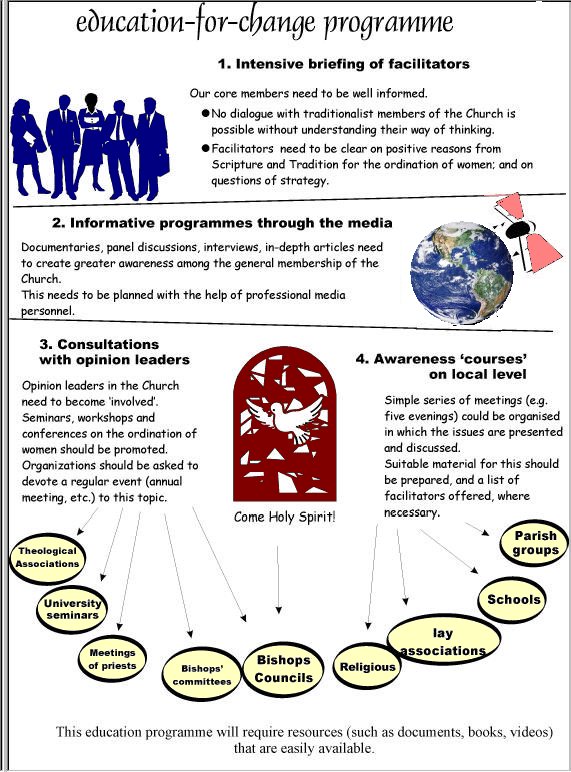
The diagram I presented at the international WOW Conference in 2001 (see below) is still quite useful today.

Women should be at the altar in liturgical settings

Though the priestly ministry extends much wider than presiding over the Eucharist, it is women’s closeness to the Eucharist that will serve as a powerful symbol for traditional Catholics.
1. Women already function in eucharistic worship as members or directors of the choir. This is an advance, since until 1917 women were forbidden to be members of the choir by Church law. This ridiculous prohibition was reiterated more than once by the Sacred Congregation for Liturgy. “Neither girls nor adult women may be members of a church choir” (decree 17 Sept. 1897). “Women should not be part of a choir; they belong to the ranks of the laity. Separate women’s choirs too are totally forbidden, except for serious reasons and with permission of the bishop” (decree 22 Nov. 1907). “Any mixed choir of men and women, even if they stand far from the sanctuary, is totally forbidden” (decree 18 Dec. 1908).
2. In many places girls have begun to function as Mass servers, and women as readers, ministers of holy communion, preachers and as presiding over communion services. Here we have made progress. The 1917 Code of Law restricted all ministries at the altar to males (CIC 813). The new Code of 1983 which is still in force today, allows lay people, including women, to be readers, Mass servers, cantors, preachers, leaders of prayer services, ministers of baptism and communion, but only by a ‘temporary deputation’ (Canon 230, §2-3).
3. Inclusive language should be used at all times during liturgical services. Even if the officiating priest forgets to do this, other ministers such as readers and preachers should observe the rule. People will get the point.
4. During the prayers of intercession, a regular petition could be inserted asking the Holy Spirit to guide the Church in the matter of the ordination of women, or some such prayer. The formulation has here deliberately to be left open for two reasons: (a) we should not dictate to the Holy Spirit what she should do; (b) all members of the community should be able to join in the petition, whatever side they are on regarding women priests.

In this context it should be noted that ecumenical examples are helpful. Quite a few traditional Catholics are already changing their minds when they see women priests functioning so competently at weddings, funerals and on other occasions in other Christian churches.

We should encourage that pastoral authority is entrusted to women wherever possible

Present Church law forbids women to be clerics and so deprives all women of clerical offices which require the power of order or the power of jurisdiction [=church governance] (can. 219, §1 & 274 § 1). On the other hand, Church law allows women to be appointed to many tasks and this should be exploited to the full:
5. To be a member of the pastoral council of the diocese (can. 512 § 1) and of the parish (can. 536 § 1).
6. To be full members of provincial councils of bishops (can. 443 § 4), diocesan synods (can. 463 § 2 & 1.5), the finance committee of the diocese (can. 492 § 1) and of the parish (can. 537).
7. To be a financial administrator of the diocese (can. 494).
8. To be consultors on the appointment of parish priests (can. 524) and the appointment of bishops (can. 377 § 3).
9. To preach in a church or oratory – though not the homily according to present church law (!!- see can. 766).
10. To be catechists (can. 785) and to give assistance to the parish priest in the catechetical formation of adults, young people and children (can. 776).
11. To assist at marriages under certain conditions (c.1112).
12. To assist the parish priest in exercising the pastoral care of the community, as parish assistants, or as chaplains in hospitals, colleges, youth centres and social institutions (can. 519).
13. To be to be entrusted with a parish because of a shortage of priests (can. 517 § 2).
14. To administer certain sacramentals (can. 1168).
15. To hold offices in an ecclesiastical tribunal, such as being judges (can. 1421 § 2), assessors (can. 1424), auditors (can 1428 § 2), promotors of justice and defenders of the marriage bond (can. 1435).
16. To hold the diocesan offices of a chancellor or a notary (can. 483 § 2).

The women’s ordination movement should promote the ordination of women as deacons as a first step

The Church has a well-established tradition of women deacons. It is possible that Rome will make some concession in this regard.
17. Women who feel called to the ministry should be encouraged to study full theological courses.
18. Suitable candidates should be prepared to serve as deacons. However, the women’s ordination movement should never accept a watered-down version of the diaconate for women. If women are ordained deacons, this should be done on the understanding that the sacrament of the diaconate is administered to them in the same way as it is to male deacons.

All the above tasks can be taken up by women under the existing law and the opportunities offered here are not fully utilised. It is encouraging that various bishops’ conferences are promoting a better integration of women into leadership roles. While our goal firmly remains women’s full integration in the priesthood and the episcopacy, we should keep working towards and see signs of hope in all the intermediate steps on the way to the restoration of women’s ministry.

John Wijngaards

SEVEN STRATEGIES TO PROMOTE WOMEN’S ORDINATION

  1. Recognise that the SOURCE for women’s openness to ordination lies not in emancipation but in baptism.
  2. Understand Rome’s arguments for its ban on women priests and know how to refute them.
  3. Be familiar with the theological reasons for ordaining women.
  4. Create opportunities to educate people for change.
  5. Make women visible in church.
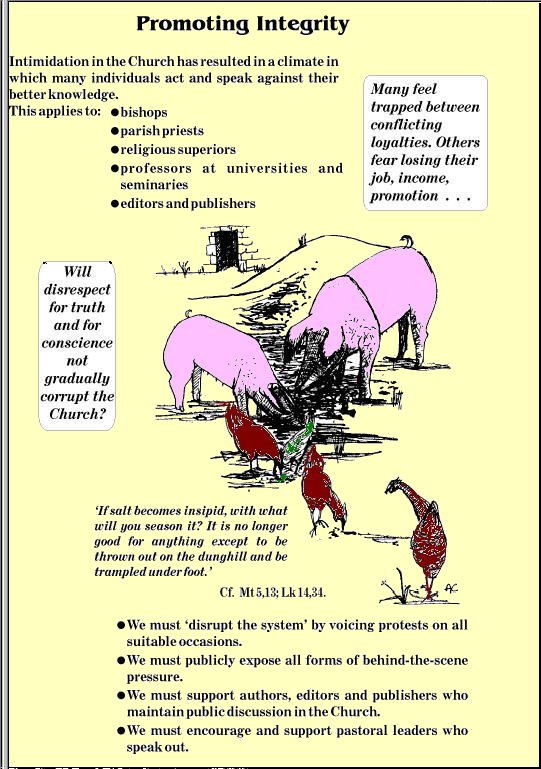
  6. Support integrity in the Church and voices of protest.
  7. Jesus Christs wants also women in the priesthood, not just men. Proclaim it!

John Wijngaards, WHAT THEY DON’T TEACH YOU IN CATHOLIC COLLEGE. Women in the priesthood and the mind of Christ, Acadian House Publishing, Lafayette USA 2020.

create opportunities to educate for change

Create opportunities to educate people for change

SEVEN STRATEGIES TO PROMOTE WOMEN’S ORDINATION, no 4


OK, we want to see women function in the Catholic Church as deacons, priests and bishops. Rightly so! But we should realise that, in order to achieve that goal, we need to change mental perceptions. Our greatest obstacle is the mixture of misconceptions and misunderstandings that underpin the conviction that those ministries have been entrusted only to men. The problem lies in the brain, in wrong ideas. It can only be remedied by a process of re-education. And in this process men too should be involved, as much as women have to be — both as teachers and learners.

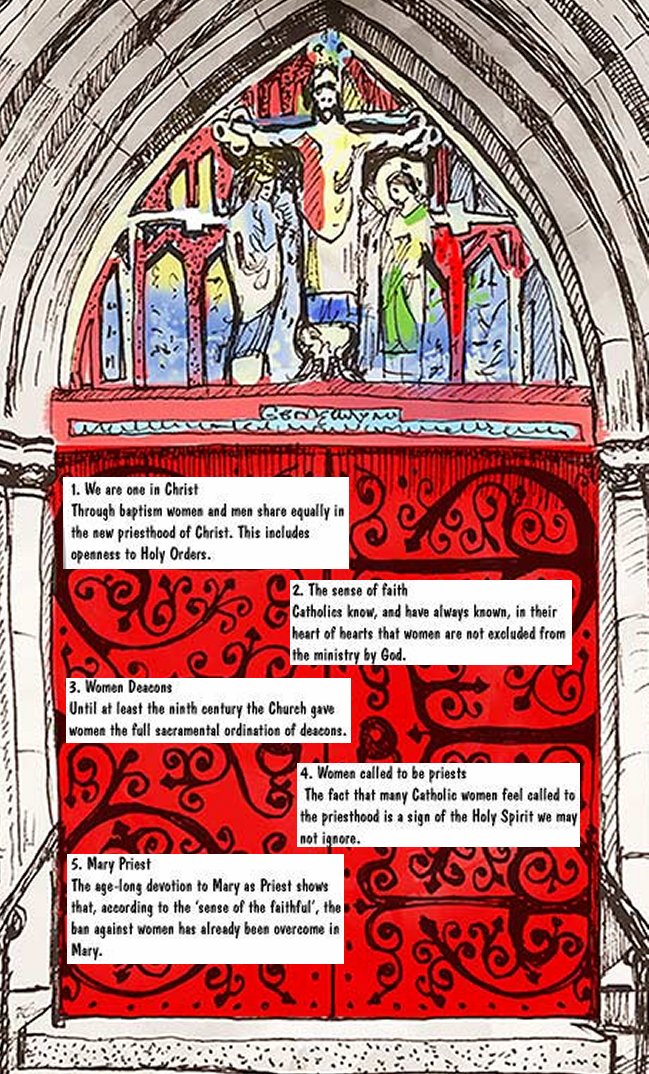
Note: The diagram that follows is taken from the presentation I gave at the WOW Conference in 2001.

It is said that “Male bishops and priests don’t want women because they enjoy the power the male-only ministry gives them. They will hang on to their patriarchal power at all costs.” But I am hopeful that, in the majority of cases, this isn’t the root cause of their refusal to accept women’s ordination. There are undoubtedly a few isolated cases of hardened ‘patriarchists’ but from my long experience of teaching young men studying for the priesthood and giving renewal courses to priests who are already in the ministry I know that they are sincere. They are not generally anti-women. They want to be faithful to what they believe is church doctrine and to their ministry. This was also confirmed by my getting to know hundreds of priests intimately as Vicar General of the Mill Hill Missionaries.
What many of them need is solid, updated information. This applies also to many lay leaders, such as pastoral assistants in parishes and teachers in schools. Where they are misinformed, we have to help them change their minds. It requires a re-education programme. Elements of this could be the following:

1. We should involve the general public in an informed discussion through the modern media.
We live in a media age and people pick up ‘the truth’ from the media. Our best tool these days is Facebook. We can reach many persons by regularly posting informative ‘news’ items on our Facebook Groups and to our own Facebook friends. These items can be links to articles available on the internet, interviews, documentaries, you name it.

2. We should organise group sessions for face-to-face discussions in well planned topics relating to women’s ordination.
In parishes, for instance, we could – in normal circumstances – arrange for a number of group sessions to discuss various aspects of women’ equality in the Church. A convenient booklet could be a tool for this. Members could be asked to acquire a copy of the booklet, and read particular sections for discussion in a specific session. If I may be so free to make this suggestion, my latest publication (see details at the bottom of the page) could serve such a purpose. It is relatively cheap, short, easy to read and covers all aspects of the question.
Alternatively, in changed conditions such as our present lockdowns, the same could be achieved by regular zoom meetings online.

3. We need to keep discussion alive among opinion leaders in the Church.

In all this we should not forget a crucial target group. In the Catholic Church the main opinion leaders are: bishops, priests, theologians, editors, authors, lecturers and teachers. All these groups belong to organisations and have regular meetings. Many of these opinion leaders are sympathetic to the cause of women priests, but they may need to be prodded to put the issue on their ‘consultation agendas’.
There is no reason why specific sessions of pastoral councils in dioceses and parishes could not be devoted to the topic of women’s participation in the pastoral ministry. The same applies even more to prayer groups in parishes, bible groups, advent or lent groups, and other women’s or men’s associations.

4. Our strategy should be to be creative and try to be positive & hopeful.
At all times we should think: by what means can we get the right persons to receive correct, updated information on what Christ really wants for women?
We should also be up-beat in our re-education programme. Struggling against patriarchal structures often seems like fighting for a lost cause. Despondency may soon set in. Support is essential, both through proper information and by mutual solidarity. The Church has faced this kind of crisis before, and reforms have happened. We can move forward with the firm conviction that what we are working and praying for, will one day become a reality.

John Wijngaards

SEVEN STRATEGIES TO PROMOTE WOMEN’S ORDINATION

  1. Recognise that the SOURCE for women’s openness to ordination lies not in emancipation but in baptism.
  2. Understand Rome’s arguments for its ban on women priests and know how to refute them.
  3. Be familiar with the theological reasons for ordaining women.
  4. Create opportunities to educate people for change.
  5. Make women visible in church.
  6. Support integrity in the Church and voices of protest.
  7. Jesus Christs wants also women in the priesthood, not just men. Proclaim it!
John Wijngaards, WHAT THEY DON’T TEACH YOU IN CATHOLIC COLLEGE. Women in the priesthood and the mind of Christ, Acadian House Publishing, Lafayette USA 2020.

Be familiar with the theological reasons

Be familiar with the theological reasons for ordaining women

SEVEN STRATEGIES TO PROMOTE WOMEN’S ORDINATION, no 3


Study the reasons for ordaining women springing from our Christian faith. This is necessary if you want to make other people understand why it is right that women too share in the ordained ministry of the priesthood. The reasons lie embedded in Sacred Scripture, in our Christian Tradition, in ancient Church practice and in reflections on the implications of our core beliefs.


Did Christ want women to be priests?
When someone is still alive, it is easy. We can ask him or her to explain what precisely he or she has in mind. After a person has died it becomes much more difficult. Sometimes we can determine their mind by uncovering explicit or implicit decisions in the person’s own life. At times we only have pointers. Let me illustrate the problem and possibilities in a fictitious human example.
Imagine Marcel Dubois being a wealthy French merchant living in Marseille. Through contacts in the French colonies he got to know about leprosy. Being a philanthropist he decided, let us say, in 1876 to establish the Marcel Dubois Leprosy Fund. Marcel invested millions of his own money in the fund. He laid down that the income of the fund should specifically be used to provide medical support to lepers. After he died, administering the fund was delegated to a board of trustees.
In the course of time the trustees faced problems. They were asked to support a political campaign to make the eradication of leprosy a top priority in Sri Lanka. They turned the request down because the founder had explicitly rejected any political involvement.
Also, it was discovered that apart from the provision of medical aid, there was a need to offer psychological care to family members of lepers. The question was raised: can the Marcel Dubois Leprosy Fund finance such care given the fact that the founder had allocated the money for medical purposes? The trustees examined the question at length. They found that Marcel, while still alive, had given a grant from the fund to a mother who was looking after her leprous child. They came to the conclusion that in giving this, Marcel himself had already implicitly decided the validity of grants for psychological care in the context of leprosy.
Through a better understanding of how the infection can be prevented, leprosy was beginning to be eradicated worldwide. The leprosy fund was building up a surplus. The question that arose was: could the fund support medical relief for other diseases, let us say AIDS? The trustees found no implicit decisions on this in Marcel Dubois’ actions, but they discovered pointers that seemed to indicate his consent.
How does this apply to the question of determining ‘the mind of Jesus’ on the ordination of women? Like in the fictitious example discussed above we should explore a number of questions:
• Did Jesus at any time explicitly rule out women’s taking part in the ordained ministries? We can prove that the answer is a categorical NO.
• Are there pointers in his life that show Jesus would have been open to women ministering as priests? We have abundant evidence of Jesus’ extraordinary respect for, and openness to, women.
• Did Jesus take implicit decisions that show he wanted women to be included in the ministry? Yes, he did. He established a rite of initiation, the sacrament of baptism, which is identical for men and for women. And women were there at the Last Supper when he commissioned all his disciples, bot women and men: “Do this in memory of me!”
Last not least, can we determine Christ’s mind for the Church today, what he wants in our own time? Yes, we can. Jesus was not just a human founder. He poured his own Spirit into us. He promised that in future eras to come that Spirit would reveal his mind to us.

John Wijngaards

SEVEN STRATEGIES TO PROMOTE WOMEN’S ORDINATION

  1. Recognise that the SOURCE for women’s openness to ordination lies not in emancipation but in baptism.
  2. Understand Rome’s arguments for its ban on women priests and know how to refute them.
  3. Be familiar with the theological reasons for ordaining women.
  4. Create opportunities to educate people for change.
  5. Make women visible in church.
  6. Support integrity in the Church and voices of protest.
  7. Jesus Christs wants also women in the priesthood, not just men. Proclaim it!
John Wijngaards, WHAT THEY DON’T TEACH YOU IN CATHOLIC COLLEGE. Women in the priesthood and the mind of Christ, Acadian House Publishing, Lafayette USA 2020.

Understand Rome’s arguments and refute them

Understand the arguments Rome gives for its ban on women priests and know how to refute them

SEVEN STRATEGIES TO PROMOTE WOMEN’S ORDINATION, no 2


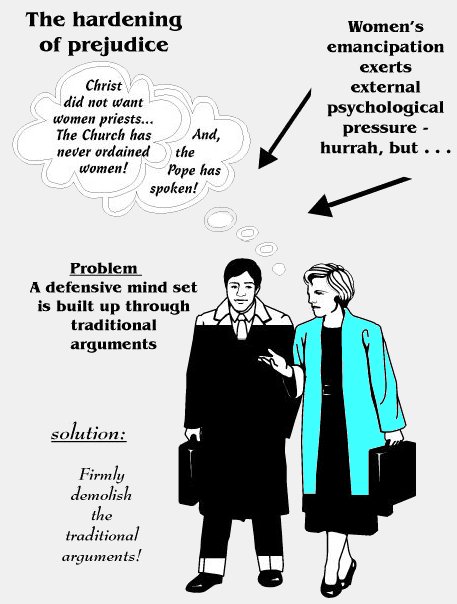
Campaigners for women’s ordination sometimes think that beating the drum of women’s rights will bring opponents round – but will it? Do we then not underestimate the power of defence mechanisms? Did the Protestant ridicule of Mary in previous centuries not result in more fervent devotion to her among Catholics? Have we not seen that forced religious attendance in Catholic schools produced youngsters who hated going to Mass? Does external pressure not often generate the opposite effect? Let us not forget that opposition to women priests is basically a prejudice.


As psychological studies have shown, prejudice feeds on its own kind of reasoning. Prejudice justifies its hostility through arguments that pretend to be reasonable. “Prejudice is an emotional rigid attitude that leads one to select certain facts for emphasis, blinding one to other facts.” Prejudice bases itself on “selective, obsolete and faulty evidence”. Bias against African Americans, for instance, rested on the claim that they were an inferior race with bogus assertions made about their intelligence and nature being different to that of white people.

With regard to women as priests, prejudice has ready-made arguments that go back to the Middle Ages. “Jesus did not choose women priests. The Church has never admitted women to holy orders, and-so-on” Arguments used to shore up a prejudice have to be taken seriously because the first step in dismantling a prejudice is for those who hold it to recognise that its basis is false. It requires challenging the truth of one’s reasons and one’s rationalisations. Overcoming the bias against black people, to go back to our example, called for a recognition of their full humanity and exact same levels of intelligence and abilities as white people.

Bishops, priests or lay people who think it was Jesus who excluded women, should be brought to an awareness of the emptiness of that claim. And their smug assertion that “it was never done” can be demolished by the indisputable evidence that women were admitted to the holy orders of the diaconate through a full sacramental rite of ordination.
The need of a concerted effort to spread correct information follows also from the behaviour of social groups when faced with outside criticism. Remember ‘group indoctrination’, a phenomenon well known from present-day ‘sects and cults’ who try to immunise their members by inculcating their own world view. Throughout the centuries the Church has often acted in a similar fashion. Because of Protestant propaganda and even persecution in some countries, the post-reformation Catholic Church screened itself off as a fortress ‘to protect the faithful’. It produced catechisms to counteract attacks by opponents. A similar development is happening now.
Church leaders are well aware of the pressure exerted by women’s emancipation in society. Over the past sixty years they have built up an official ideology that tries to spell out ‘why the Catholic view is different’. For people who feel insecure in their Catholic identity, the ‘official position’ is gratefully seized upon. It is not uncommon for women, for instance, to defend the ban against women priests with an appeal to the traditional arguments. They need those arguments to explain to themselves and to others why the Pope is right when he says that the exclusion of women from the ministry is not a denial of their dignity or equal status in the Church.

John Wijngaards

SEVEN STRATEGIES TO PROMOTE WOMEN’S ORDINATION

  1. Recognise that the SOURCE for women’s openness to ordination lies not in emancipation but in baptism.
  2. Understand Rome’s arguments for its ban on women priests and know how to refute them.
  3. Be familiar with the theological reasons for ordaining women.
  4. Create opportunities to educate people for change.
  5. Make women visible in church.
  6. Support integrity in the Church and voices of protest.
  7. Jesus Christs wants also women in the priesthood, not just men. Proclaim it!

John Wijngaards, WHAT THEY DON’T TEACH YOU IN CATHOLIC COLLEGE. Women in the priesthood and the mind of Christ, Acadian House Publishing, Lafayette USA 2020.

Recognise the true source of women’s equality in the Church

Recognise that the SOURCE for women’s openness to ordination lies not in emancipation but in baptism

SEVEN STRATEGIES TO PROMOTE WOMEN’S ORDINATION, no 1

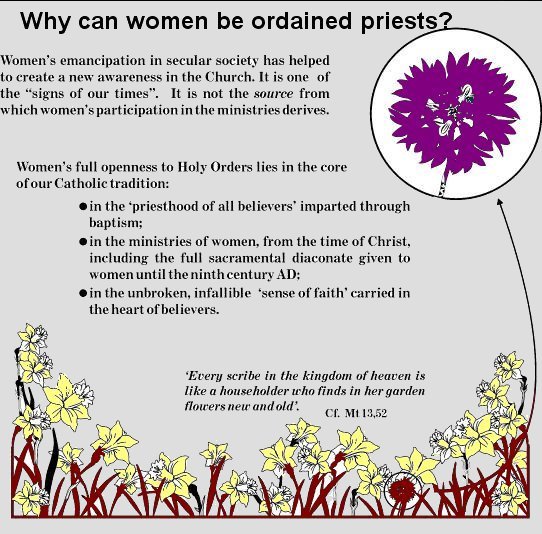
Opponents of women’s ordination usually claim that the desire for ordination arises from the contemporary drive for equal rights. They portray the demand for women priests as a modern and novel idea, a secular invention, the intrusion of profane social equality into the sacred precincts of the liturgy, a giving in to strident feminist bullying. Pope Paul VI’s Inter Insigniores blames both women’s emancipation and ecumenical pressure from other Churches. But while it is true that the climate of social emancipation has helped to raise the question of women’s absence from the ministries, the real origin of the demand lies in our common baptism.

Since Vatican II women theologians have brought a new dimension to the Church. They began to systemically expose the inequality between men and women in all areas of Catholic life: in worship and spirituality, in the parish and in the home, in theology as well as in law. They re-examined the roles of women in the early Church and drew consequences from this for New Testament exegesis. They studied in detail women’s lives during various periods of the Church’s history. They brought new light, from a woman’s perspective, on matters of liturgical language, imagery and church symbolism. But none of these women theologians, to my knowledge, claimed that the equality of women in Christ derives from secular or civil rights. We have to carefully distinguish between external impulses on a doctrine and its Christian source.

The Second Vatican Council recognised that the Church should pay attention to what modern society is telling us. We should listen to the signs of our times. We are told to “decipher the authentic signs of God’s presence and purpose in the happenings, needs and desires which Christians share with other people of our age”. The Council endorsed present-day society’s concern for equal rights and it singled out the emancipation of women as an important issue. “For in truth”, the Council declared, “it must be regretted that fundamental personal rights are still not being universally honoured. Such is the case of women who are denied the right to choose a husband freely, to embrace a state of life or to acquire an education or cultural benefits equal to those available to men.” Now it is a fact that the rise of women in society does put pressure on the Church. It forces Catholics to answer the question: “Why are women still denied the sacrament of ordination and access to power structures in the Church?” But these wholesome external promptings are not themselves the justification for demanding women’s ordination.

That demand comes from our common baptism in Christ. For there is nothing that distinguishes the baptism of a man from that of a woman. As Paul said: “All who are baptised in Christ have put on Christ himself. So there is no difference between men and women … You are all one in Christ Jesus” (Galatians 3, 26-28). Because we do not live any longer in Old Testament times, we do not realise how significant this fact is. The Israelites were God’s people, yes, but the men were more God’s people than the women. Men did not only dominate in the home and in society. Men enjoyed a privileged status in religion. Only the men were circumcised. The covenant was made directly with them. Women belonged to the covenant through their fathers and husbands. The men had to sacrifice in the Temple. The men read the Torah in the synagogues. Women could take part if they wished, but then from a distance. Christ overthrew this fundamental discrimination.

Both men and women equally die with Christ and rise with him to new life. Both men and women become members of his new covenant, and share in his eucharistic meal on an equal footing. Both men and women in like manner share in Christ’s priestly, prophetic and royal dignity. The openness of women to the ordained ministry arises from within the sacrament of baptism itself. The cry for social equality may have woken us up. The truth of equality in Christ’s covenant has always been there.

The demand for the ordination of women arises from the centre of our Catholic faith. Read more about baptism here.

John Wijngaards

SEVEN STRATEGIES TO PROMOTE WOMEN’S ORDINATION

  1. Recognise that the SOURCE for women’s openness to ordination lies not in emancipation but in baptism.
  2. Understand Rome’s arguments for its ban on women priests and know how to refute them.
  3. Be familiar with the theological reasons for ordaining women.
  4. Create opportunities to educate people for change.
  5. Make women visible in church.
  6. Support integrity in the Church and voices of protest.
  7. Jesus Christs wants also women in the priesthood, not just men. Proclaim it!
John Wijngaards, WHAT THEY DON’T TEACH YOU IN CATHOLIC COLLEGE. Women in the priesthood and the mind of Christ, Acadian House Publishing, Lafayette USA 2020.

Pope Francis on women leaders in the Church

The Pope on women leaders in the Church

10 October 2020

The Pope wants women to have more leadership in the Church, but he restricts this to ‘lay’ functions such as administration, pastoral care. It is totally inadequate. When Jesus gave leadership to his Apostles, he gave spiritual power: to proclaim the message, baptise, forgive sins, preside at the Eucharist. Moreover, Church Law gives all real decision-making authority to ordained ministers.

See him on  a video presentation: www.youtube.com/watch?v=TyeKkYnJnKA&feature=youtu.be