
Support integrity in the Church and voices of protest
SEVEN STRATEGIES TO PROMOTE WOMEN’S ORDINATION, no 6
In recent decades, especially under Popes John Paul II and Benedict XIV, Rome unleashed an unprecedented ‘reign of terror’ in the Church with the express purpose of suppressing all further discussion on women priests. Powerful measures of organisational control were put in place and were being constantly monitored. Whatever intentions these two Popes may have had, they inflicted lasting damage on the Church. We still suffer from the consequences.
The Reign of Terror: Popes John Paul II and Benedict XIV
These two Popes made a concerted effort to suppress any voices calling for women to be ordained. The following facts have been documented with evidence.
• Bishops. Only those men were elected as candidates for the episcopacy who undertook, usually on oath, not to promote the ordination of women. Constant pressure was put on bishops ‘to resolutely refuse any support to those people, whether individuals or groups, who defend the priestly ordination of women, whether they do so in the name of progress, human rights, compassion or whatever reason it may be’. Individual bishops received detailed instructions from Rome regarding supposed ‘dissidents’ in their dioceses. The Synods of Bishops, which were instituted by the Vatican Council to curb curial monopoly, have been deprived of any real influence by a rigging of the agenda, by saturating committees with members of the Roman Curia, by a subtle censorship of bishops’ contributions, by selectively omitting resolutions voted on by the bishops.
• Religious Superiors. Whenever a man or woman religious expressed disagreement with Rome’s view on women priests, Roman Congregations leant on the Superior General concerned. Usually this happened behind the scenes and religious superiors were urged to keep Rome’s intervention secret, but some cases have come out into the open. In October 1994, fourteen prominent Religious Sisters in India belonging to ten different Religious Congregations addressed their objections to Ordinatio Sacerdotalis in a letter to the Holy Father. All the Congregations were put under pressure. The Sisters involved were reprimanded.
• Theologians. Professors in seminaries and theological colleges are required to swear the oath of loyalty which now, since Ad Tuendam Fidem (28 May 1998), includes agreement to the ban on women priests. Theologians have been dismissed from their teaching posts because of their views on the ordination of women. Others have been warned that they will be dismissed if they speak out on the issue. Rome issued new instructions that put Catholic Colleges under more direct ecclesiastical control. I know of cases where theologians were admonished by their bishops, on instigation of Rome, because they had allowed their articles to be published on the women priests’ web site. Last year the Bishops’ Conference of England and Wales withdrew sponsorship of a theological conference in Newman College, Birmingham, because I was one of the speakers.
• Editors, Writers, Publishers. Many Catholic newspapers and magazines were vulnerable because they are owned by dioceses or by publishing houses owned by religious congregations. Rome issued strict instructions to book censors not to give the Imprimatur or Nihil Obstat to books favourable to women priests. The Liturgical Press of St. John’s Abbey, Minnesota, North American publisher of Woman at the Altar by Lavinia Byrne, allegedly burnt its stock of 1300 copies when it was informed by the local bishop that Rome was displeased with the book. A number of Catholic publishers to whom I showed the manuscript of The Ordination of Women in the Catholic Church. Unmasking a Cuckoo’s Egg Tradition, responded with: “We’d love to publish a book like that, but we can’t in the present climate in the Church!”
• Parish Priests, Lay leaders. Through the new oath of loyalty priests too were put under pressure to fall in line with Rome’s opposition to women priests. The ban to women priests was incorporated into central Church documents: Church Law (can. 1024), the official Catechism (§ 1577).
• Congresses and Meetings of Catholic Organisations. The outcome of such consultations was often manipulated by Roman interference. An infamous example is the Third World Congress for the Lay Apostolate (Rome 1967) that manifested the wide range of ‘hierarchical control mechanisms’ that Rome has used ever since.
The Climate of Dishonesty
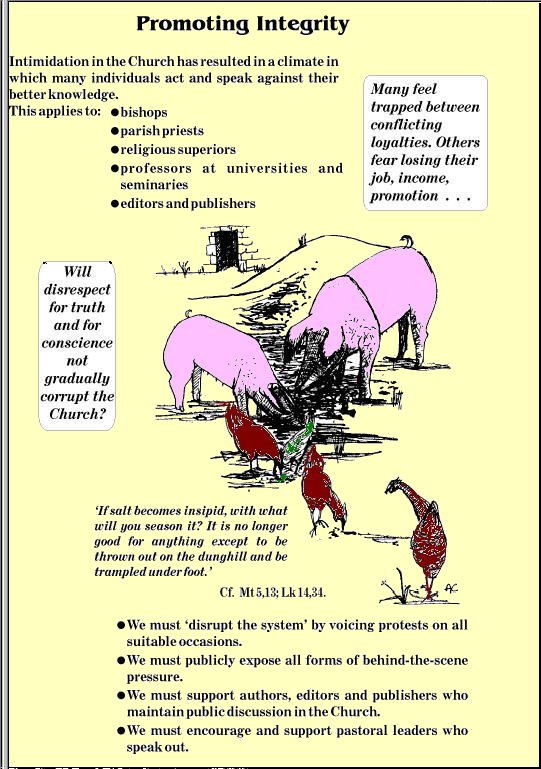
The intimidation from above resulted in a climate in which many individuals and groups acted and spoke against their better knowledge. They felt trapped between conflicting loyalties. On the one hand, they did not want to disobey authority or risk their jobs and positions. On the other hand, they realised that Rome’s stand against women priests is really untenable and is doomed to fail. This became a problem of conscience which was ‘resolved’ with the help of classical rationalisations:
“Authority has spoken. I have to obey.”
“Everybody else toes the party line. Why should I risk my neck?”
“Another Pope will surely change this policy, meanwhile I better comply . . .”
“It is better for the people entrusted to me that I keep my job.”
It is not my intention here to condemn the persons who feel caught in this terrible dilemma. Their struggle is real. I can sympathise with them. But what happens when everyone finds excuses? Integrity, truth and credibility suffer. If bishops, priests, theologians comply and even swear oaths with bad consciences, the Church itself is gradually being corrupted.
We have seen the results in the world-wide Catholic child abuse scandal. It came about because bishops and other church leaders, usually against their own better judgment, protected priests who were abusers and ignored the plight of their victims. They had been instructed to do so by Rome “to safeguard the reputation of the Catholic Church” (!).
The situation in the Church has slightly improved under Pope Francis. But God’s People are still at the mercy of many arch-conservative bishops. Catholic Colleges and Catholic theologians still feel power-hungry curial officials breathing down their necks.
Conclusion
What is more vital in theology than that the truth be sought out without inhibitions and freely discussed? What is more important for the teaching authority than that its opinions can be trusted? What is more dreadful to the People of God than that they are reduced to a bunch of puppets held by a string?
For the good of the Church and to bring about far-reaching reforms we have to speak out fearlessly.
John Wijngaards
SEVEN STRATEGIES TO PROMOTE WOMEN’S ORDINATION

- Recognise that the SOURCE for women’s openness to ordination lies not in emancipation but in baptism.
- Understand Rome’s arguments for its ban on women priests and know how to refute them.
- Be familiar with the theological reasons for ordaining women.
- Create opportunities to educate people for change.
- Make women visible in church.
- Support integrity in the Church and voices of protest.
- Jesus Christs wants also women in the priesthood, not just men. Proclaim it!