
Understand the arguments Rome gives for its ban on women priests and know how to refute them
SEVEN STRATEGIES TO PROMOTE WOMEN’S ORDINATION, no 2

Campaigners for women’s ordination sometimes think that beating the drum of women’s rights will bring opponents round – but will it? Do we then not underestimate the power of defence mechanisms? Did the Protestant ridicule of Mary in previous centuries not result in more fervent devotion to her among Catholics? Have we not seen that forced religious attendance in Catholic schools produced youngsters who hated going to Mass? Does external pressure not often generate the opposite effect? Let us not forget that opposition to women priests is basically a prejudice.
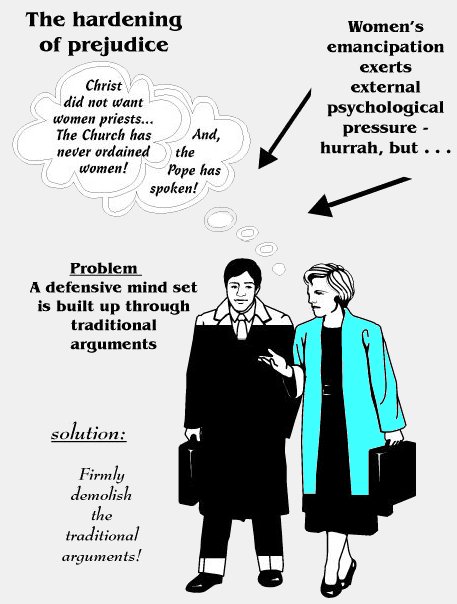
As psychological studies have shown, prejudice feeds on its own kind of reasoning. Prejudice justifies its hostility through arguments that pretend to be reasonable. “Prejudice is an emotional rigid attitude that leads one to select certain facts for emphasis, blinding one to other facts.” Prejudice bases itself on “selective, obsolete and faulty evidence”. Bias against African Americans, for instance, rested on the claim that they were an inferior race with bogus assertions made about their intelligence and nature being different to that of white people.
With regard to women as priests, prejudice has ready-made arguments that go back to the Middle Ages. “Jesus did not choose women priests. The Church has never admitted women to holy orders, and-so-on” Arguments used to shore up a prejudice have to be taken seriously because the first step in dismantling a prejudice is for those who hold it to recognise that its basis is false. It requires challenging the truth of one’s reasons and one’s rationalisations. Overcoming the bias against black people, to go back to our example, called for a recognition of their full humanity and exact same levels of intelligence and abilities as white people.
Bishops, priests or lay people who think it was Jesus who excluded women, should be brought to an awareness of the emptiness of that claim. And their smug assertion that “it was never done” can be demolished by the indisputable evidence that women were admitted to the holy orders of the diaconate through a full sacramental rite of ordination.
The need of a concerted effort to spread correct information follows also from the behaviour of social groups when faced with outside criticism. Remember ‘group indoctrination’, a phenomenon well known from present-day ‘sects and cults’ who try to immunise their members by inculcating their own world view. Throughout the centuries the Church has often acted in a similar fashion. Because of Protestant propaganda and even persecution in some countries, the post-reformation Catholic Church screened itself off as a fortress ‘to protect the faithful’. It produced catechisms to counteract attacks by opponents. A similar development is happening now.
Church leaders are well aware of the pressure exerted by women’s emancipation in society. Over the past sixty years they have built up an official ideology that tries to spell out ‘why the Catholic view is different’. For people who feel insecure in their Catholic identity, the ‘official position’ is gratefully seized upon. It is not uncommon for women, for instance, to defend the ban against women priests with an appeal to the traditional arguments. They need those arguments to explain to themselves and to others why the Pope is right when he says that the exclusion of women from the ministry is not a denial of their dignity or equal status in the Church.
John Wijngaards
SEVEN STRATEGIES TO PROMOTE WOMEN’S ORDINATION

- Recognise that the SOURCE for women’s openness to ordination lies not in emancipation but in baptism.
- Understand Rome’s arguments for its ban on women priests and know how to refute them.
- Be familiar with the theological reasons for ordaining women.
- Create opportunities to educate people for change.
- Make women visible in church.
- Support integrity in the Church and voices of protest.
- Jesus Christs wants also women in the priesthood, not just men. Proclaim it!