
No justice for the poor?
by John Wijngaards
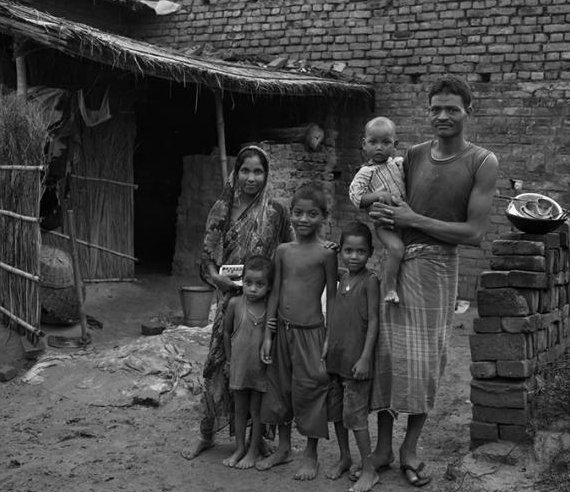
In July 1968 our professor of moral theology, Fr Eddie Bennett, was away to give a course in Jabalpur, North India. He had asked me to open his mail and forward to him any post that might be significant.
One day a heavy envelope came in. It had been sent by the papal nunciature in New Delhi. Intrigued I slit it open at the edge and found a document. It was a copy of detailed instructions from the Roman Congregation for the Doctrine on the Faith to all moral theologians in India. It announced the imminent release of the encyclical Humanae Vitae (‘On Human Life’) by Pope Paul VI. This proclaimed that all artificial forms of family planning were in conflict with Natural Law and should therefore be avoided in all circumstances.
We were all aware that a papal commission of experts had, for a number of years, been studying the question of artificial birth control. The signs had been positive. The commission recommended [with a majority of 68 to 4!] that Catholic couples should be allowed to, responsibly, use artificial methods in planning their families. It looked as if Rome would soften its stand against contraceptives. The opposite happened. In spite of the advice of his experts the Pope condemned all artificial means:
“Any action which either before, at the moment of, or after sexual intercourse, is specifically intended to prevent procreation—whether as an end or as a means… is wrong. It is never lawful, even for the gravest reasons, to intend directly something which of its very nature contradicts the moral order, and which must therefore be judged unworthy of man, even though the intention is to protect or promote the welfare of an individual, of a family or of society in general. Consequently, it is a serious error to think that a whole married life of otherwise normal relations can justify sexual intercourse which is deliberately contraceptive and so intrinsically wrong.”
I was stunned. I could immediately see the devastating impact it would have on poor families all over India. St Augustine’s footprint ran all over the text. Had he not taught that the only legitimate purpose for intercourse lay in procreation? Sex desires did not come from God, he said. They come from evil, from original sin, from the devil. Medieval scholars had linked this to their perception of ‘natural law’, a law which the Creator was alleged to have enshrined in nature.
A devastating blow for the poor
I had also got to know recent converts Mary and Joseph. Joseph was a carpenter. He was a Hindu of low-caste origin who applied for baptism because he wanted to marry Mary who was a Catholic. I was involved to some extent in the preliminary instruction, and later in his baptism itself. They were gentle, unassuming people, genuinely lost in a harsh world. I could not help seeing in them an Indian incarnation of the Holy Family… They would have jumped at a stable for accommodation!
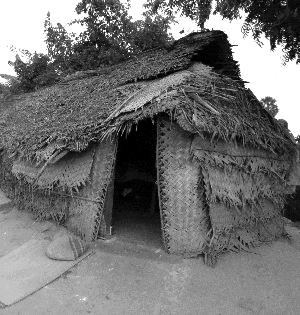 I visited them in their tiny reed-matted- lean-to hut in Ramnagar. They lived in the shadow of a Parsi Tower of Silence. This burial tower was a two-storey hollow building covered with a lattice of iron bars instead of a roof. As you may know, Parsis believe that human bodies should neither be interred nor cremated. They deposit the naked corpses of their dead on the roof trellis so that birds of prey can pick off the flesh and the bones fall down into the pit below. The whole area around the Ramnagar Tower of Silence stank of corpses. Mary and Joseph lived in a place normal people would shun as hygienically and religiously unclean.
As I crept into the hut I found Mary with her latest child. She was a girl. A two-year old elder brother was sitting on the dust floor looking at me with large inquiring eyes. I was offered a mug of tea. Joseph told me he had a temporary job on a building plot. Mary narrated that she had paid a visit to her parents’ home in a country village.
“I wasn’t welcome”, she said with tears in her eyes. “I wasn’t welcome in the home I grew up in. When I came near the door, I overheard my mother say to the others: ‘I hope that’s not Mary who is coming. For God’s sake! What can I give her to eat?!’… ”
“My mother has had seven children”, she added by way of explanation. “My father died.”
I did not know what to say.
Then she said to be again: “Look where we live. Joseph is not getting a proper wage. They take advantage of him. How can we survive?”
And with a weary look on her face: “Father, in my whole life I have never known comfort.” Her literal words in Telugu were: “Nâ jîvithamulô sukham thêlêdhu”. I will never forget. These words still ring in my ears after so many years. I hear them as a reproach when I enjoy comfort myself. I wish I could have done more for them.
I was called out to Osmania General Hospital in Hyderabad some time later. Mary and Joseph’s third child was dying. I found them in the emergency clinic for children, standing helplessly near a cot where the baby lay linked to a life-support machine. Its emaciated body was still breathing. Dysentery, I was told. I prayed over the baby. It died soon afterwards.
It illustrated the major problem compounding abject misery in India, namely the number of children born to poor parents. It did not give undernourished mothers time to recover from the hardships of childbirth. It added to the burden of feeding, clothing and educating children. Family planning was essential to help the poor rise above starvation level, as the government of India recognized, But what support did the Church offer? Nothing. People like Joseph and Mary were forbidden to avail themselves of a condom or an IUD (intra-uterine device) provided by the government. So were the other one third of the population, 200 million at the time, who lived under the poverty line!
Pope Paul VI was wrong. Theology has indisputably proved that the responsible use of contraceptives is not against Natural Law. People all over the world were made to suffer unjustly.
 Excerpt from Chapter 7 in Ten Commandments for Church Reform. Memoirs of a Catholic Priest, by John Wijngaards (Acadian House Publishing 2021; 256 pages, 75 photographs).
The book is available in USA and UK bookshops. Main distributors are Acadian House in the USA – click here, and Gazelle Book Services in the UK – click here.
It can also be ordered through Amazon (USA: $ 20.90; UK: £ 15.78).
For more information about the book, read here!