
My priestly heroes
by John Wijngaards
When I was studying to become a priest in the 1950’s I reflected and prayed a lot about what kind of priest I should be. I noted outstanding examples in my spiritual diary.
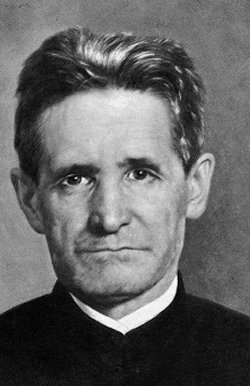 A priest who spoke to my heart was Rupert Mayer. He had acquired lasting fame as one of the earliest and most outspoken opponents of Hitler. He spent nine years in prison for his damning of Nazism: “No Christian may ever be a Nazi!”, he kept saying. But that was not the main reason why thousands of Germans kept visiting his shrine in the crypt of St Michael’s Church at Munich. He was a priest who won people’s hearts because he went to meet them where they were.
As chaplain to the Eighth Bavarian Division during World War I, he could have opted for safety, well behind the lines. Instead, he stayed in the trenches, crawling from one outpost to the other, heartening the living and comforting the dying. We can imagine what that means when we learn that his division was decimated in 1916 during the battle of the Somme. The particular battalion he served was reduced from 900 troops to 220 in eight days. Of the new strength of 770 troops with which the battalion was hastily reinforced, 650 became casualties in the next week. The official despatch reads: “Throughout these devastating attacks from 20 July to 13 August, one man stayed put in the front line: Padre Mayer. Under withering artillery fire he saved many lives by giving first aid and by carrying the wounded to safety.” Having earned three military distinctions and the Iron Cross in two years of service, he lost his left leg when shrapnel shredded his knee.
The collapse of Germany after the war was almost as dreadful an experience as the war itself: disruption of families, unemployment, poverty, political confusion everywhere. Rupert Mayer, now limping parish priest of St. Michael’s in Munich, proved once more his closeness to the people. He visited the sick and the poor, organized the men in a strong Marian sodality and joined political rallies in the tumultuous Bierhallen. It was here that he challenged first the Communists, then Hitler and his associates. Repeatedly he was shouted down. On one occasion a bully kicked against his wooden leg and sent him sprawling to the ground. But, whether friend or foe, people knew that here was a priest who spoke their language and cared for them.
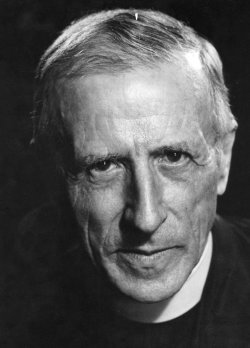 Then there was Teilhard de Chardin who had also served in the First World War. Teilhard was French. As a stretcher-bearer in the 8th Moroccan Rifles he was constantly in the midst of enemy fire comforting and rescuing the wounded. For his courage he was awarded the Médaille militaire and the Legion d’Honneur.
Teilhard became a Jesuit scholar who combined expert knowledge of paleontology with profound present-day mysticism. His name as a scientist was secured when during one of his many geological expeditions to China, he was involved in the excavations at the so-called Peking Man site of Zhoukoudian, near Beijing. Teilhard helped establish that Peking Man belonged to the species of hominids called Homo Erectus and dated more than half a million years ago.
Next to his long and fruitful academic work, Teilhard also developed a revolutionary approach to understanding the evolution of human beings. In the seminary, I was thrilled reading his books such as The Phenomenon of Man, The Divine Milieu and Hymn of the Universe. Teilhard was a different kind of priest than Karl Mayer and, yet, he too was a hands-on spiritual leader, not a sanctuary-hugging thurible-swinging cult man. And this is what I liked about real priests, as I called them. They could not be put into a narrow mould. They responded to the needs of the Catholic community in exciting unexpected ways.
Mayer had been persecuted by the Nazis. Teilhard faced other enemies: conservative theologians in the Vatican. His writings were censured. He was forbidden to publish some of his best work during his lifetime. Fortunately, friends published them for him after his death. It prepared me for the opposition a dedicated priest might face from even within his own Catholic community. And as I am writing these lines, the warnings against Teilhard’s thinking are still not fully lifted by the Congregation for the Doctrine of the Faith.
Priests for people
The academic courses we studied at Mill Hill College – theology, sacred scripture, liturgy – were woefully substandard. Fr Duivestein (‘Duivy’ in students’ parlance) entertained us with lengthy lectures on angels: Do they have wings? Are cherubim different from seraphim? Do they rank higher than human beings, but then: what about Christ? And so on. It so happened that the statue of a guardian angel along the lane leading to the entrance of the college was accidentally damaged by a passing car – below the angel’s belt. Immediately a rumour did the rounds: “Duivy is delighted. He can now verify for himself whether angels are male or female!”
Only moral theology and church law stood out under the tuition of Fr Serafino Masarei. We were not aiming at becoming scholars, however. We wanted to set the world ablaze with the revolutionary vision brought by Christ. So a number of us looked around to supplement our formation with other energetic teachers.
One such person was Father Bernard Bassett who had been a chaplain to the Royal Air Force. He dreamt of transforming a passive laity into vigorous apostolic teams. So he founded the Cell Movement which consisted of a wide network of laypeople connected mainly through the telephone. The network could trigger national campaigns, such as making hundreds write to newspapers to support Christian values when moral issues were debated. The network also initiated the push to ‘Put Christ Back into Christmas’ and helped Britain focus on fairness to the Third World.
I read a number of Fr Basset’s books – Priest in the Piazza, Seven Deadly Virtues – and attended his courses in the centre of London. In one talk to seminarians he spoke these memorable words:
“Whatever you become as a priest, don’t be a wimp. Christ’s cause is not served by weak and spineless cowards. Stand with both legs firmly on today’s ground and be prepared to wade through the muck and mud of real life.”
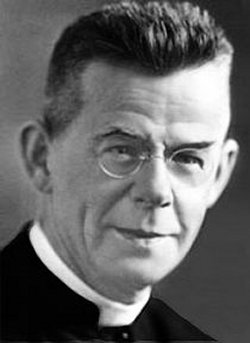 I also admired the Flemish priest Josef Cardijn. Hailing from a working class family himself, he was moved by the struggles of the men and women who toiled in Brussels’ sprawling industrial estates. He saw that these workers needed to liberate themselves from their degrading circumstances through their own action. The trade unions usually failed because they did not address the root problems and ignored Christian principles. So he founded the Young Christian Workers (YCW).
Bringing groups of workers together he taught them the method of ‘see, judge and act’. Seeing required becoming aware of the facts. The group had to judge these facts according to Christian principles of justice for all. They then had to decide on a concerted plan of action. The YCW soon grew out into a vast and influential movement that formed generations of Christian leaders.
As Cardijn told priests in 1951:
“It isn’t enough to preach to laypeople. The priest must go further; he must awaken in the laity a desire for the apostolate. He must help, encourage and guide them… The priest must develop a profound sense of this responsibility, as well as the qualities which are needed to put it into action: human capabilities, fraternal love, a vision of the world and of the Church, boldness, courage, perseverance. A great many socialists, communists and other militants who set up human messianic movements are to be admired for their deep sense of responsibility, their strong will and their steadfastness and toughness in action.”
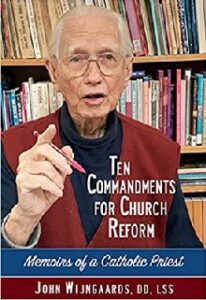 Excerpt from Chapter 7 in Ten Commandments for Church Reform. Memoirs of a Catholic Priest, by John Wijngaards (Acadian House Publishing 2021; 256 pages, 75 photographs).
The book is available in USA and UK bookshops. Main distributors are Acadian House in the USA – click here, and Gazelle Book Services in the UK – click here.
It can also be ordered through Amazon (USA: $ 20.90; UK: £ 15.78).
For more information about the book, read here!