
Christ is born in you and me
by John Wijngaards, Christmas 2021
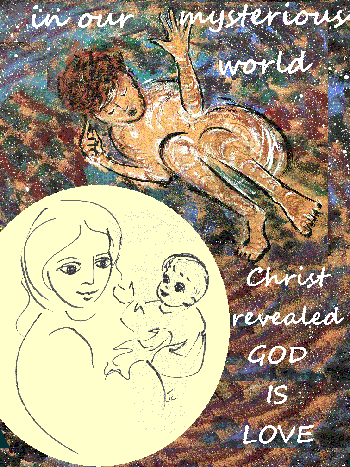
Our Christmas carols keep celebrating Christ’s birth in Bethlehem. This may lead us astray. For what we should really celebrate is Christ’s birth in each of us. That is where the true meaning of Christmas lies. Jesus assured us: “Anyone who loves me will obey my teaching [of love]. My Father will love that person, and we will come and make our home in each of them” (John 14,23). “God is love, and whoever lives in love lives in Godm and God lives in that person” (1 John 4,12).
In other words: if we believe and make Christ’s teaching on love our own, he is reborn in us so that we too can radiate God’s love in our words and actions.
This was how the Fathers of the Church understood Jesus’s birth. “What use is Christ’s birth from the holy Virgin, if he is not born in my heart?” asked Origen (184 – 253 AD).
This even applied to Mary. Her giving birth to Christ physically was important of course, but even more so her accepting divine motherhood mentally and spiritually. Pope Leo the Great (400 – 461 AD) asserted that Mary conceived her divine child “in her mind before she received him in her body”. St Augustine (354 – 430 AD) put it even more strongly. “Mary is more blessed for accepting faith in Christ than for conceiving his flesh. Her nearness as a mother would not have profited Mary, had she not given birth to Christ in her heart in a more blessed manner than in her flesh.” In other words: her spiritual motherhood counts more than her physical motherhood.
But if Mary gave birth to Christ in her heart by believing in him, does the same not happen to every believer? Quoting Paul’s phrase “till Christ be formed in you” (Galatians 4,19), the Fathers of the Church point out the parallelism. Says Gregorv the Great (540 – 604 AD): “Exactly the same which once took place physically in the Virgin Mary – namely that the fullness of God in Christ dawned through the Virgin – now takes place in every soul that conceives him as a virgin.” “Christ is willingly born mystically”, says Maximus (580 – 662 AD), “by taking flesh in those who are saved . . . For the Word of God wants to become flesh continuously and in all people.”
The Fathers even tell us that each one of us too, Iike Mary, can be called ‘Mother of God’. Hippolytus (170 – 235 AD) states: “The Word that proceeds from the Father is constantly born anew in saintly people. Whoever lives a life inspired by grace becomes Christ’s Mother.” “Every soul”, says Gregory of Nazianzen (329 – 390 AD), “can become Christ’s Mother. Every soul carries in itself, as in a mother‘s womb, Christ himself.” And St Ambrose (340 – 397 AD) says: “Whoever turns to God should be called ‘Mary’. For ‘Mary’ is the name of the person who gives birth to Christ and everyone can give birth to Christ spiritually.”
God’s birth in us
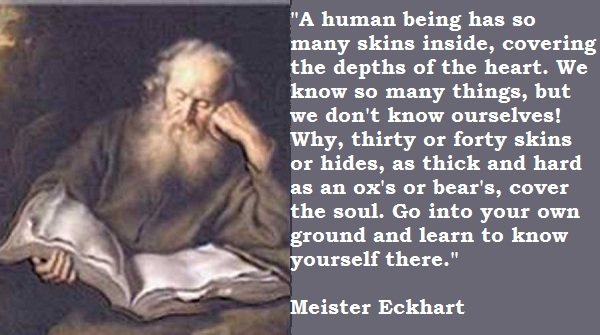
The tradition of the early Fathers reasserted itself in the more doctrinal approach of the Rhineland mystic, Meister Eckhart (1260 – 1328 AD). In thirteenth-century Germany many outstanding lay women of the middle classes sought a deeper spiritual life. As beguines they banded together in communities and turned to the Dominicans for solid instruction. Eckhart responded to their need by a daring incarnational model of spirituality. In this Mary is seen as the conscious and autonomous “Mother of God”, who like us gives birth to the Word of God by her fiat. ”I assure you: if Mary had not first given birth to God in a spiritual way, he would never have been born from her in a bodily manner. Yes, it is more precious to God that he is spiritually born from any virgin – that is: from any saintly person – than that he was born bodily from Mary.”
Eckhart’s teaching gives us matter for reflection.
“Whatever good the saints have possessed: or Mary, God’s Mother; or Christ according to his humanity is my own. For by assuming human nature. he assumed my nature.”
 “As human beings we know two births: one into the world and one out of the world, that is: spiritually into God. God effects this second birth of his Word in us, if we give up our will and accept God’s as_Mary did. For as soon as she gave up her will, she became at once the true Mother of the eternal Word and conceived God. He became her son by nature”.
Christ’s birth in us also has implications on how we look on every member of the Christian community. Each one carries responsibility for the whole community, demanding collegiality in decision making as stipulated by Vatican II. Each possesses the potential of prophecy through Christ’s Spirit, a voice that may not be suppressed. Each, whether man or woman, can in principle preside at the Eucharist celebration in Christ’s name.
Read my book “Ten Commandments for Church Reform”. More info HERE