
A most revealing Eucharist
by John Wijngaards
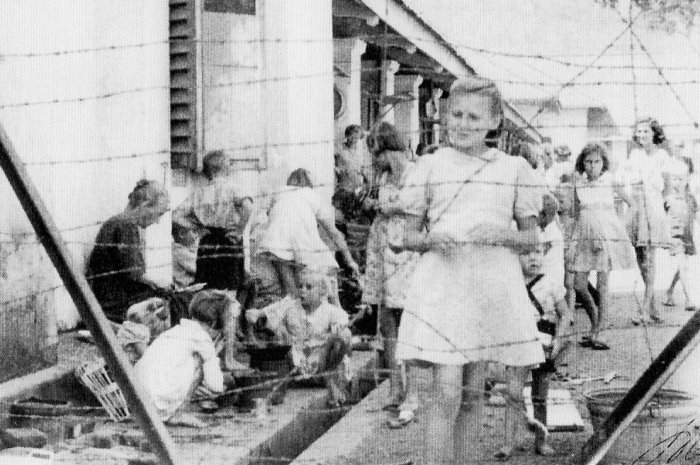
As a child I spent 4 ½ years in a Japanese prisoner-of-war camp in Indonesia with my mother and three brothers.
Mankubumen camp, also known as Bhumi camp, in the middle of Surakarta, housed 4000 prisoners. Conditions defy description. Rats, bed bugs and termites infested the barracks. No clean water. Dirty latrines. The Japs considered us cheap labour. My mother worked on construction and paving roads. Children too had to work. I remember my brother Carel and I toiling in a barren field with rows of boys of our age, preparing it for cultivation by removing stones and flattening clods of earth by hand. But the worst by far was the lack of food.
The food was prepared in a central kitchen. We received only one meal a day in our tin bowl: a portion of boiled rice with curry, just one small ladle-full for each person. Mornings and evenings we were given one table spoon full of tapioca flour in our bowl. Hot water was poured onto the flour producing a watery jelly of no substance. Day and night we were hungry, dreaming of food. I often went on a foraging trip to the kitchen. I used to crawl on all fours over the stinking rubbish heap at its back, looking for leaves of cabbage or peels of onion discarded during the preparation of the curry.
On one occasion a new group of prisoners arrived and I noticed how one family that evening threw out half-eaten sandwiches they had brought with them on a garbage dump. Ignorant inexperienced fools they were! I stealthily collected the scraps and brought them back in triumph. Later, when it was dark, the five of us huddled under our mosquito net and enjoyed the unexpected bonanza.
Our Japanese and Korean guards treated us with brutality. No surprise perhaps since a handful of them had to keep thousands of women and children in check. It was a formula that led many prisoners of war to hate the Japanese for life, each and everyone of them. I escaped that fate through a number of spiritual experiences one of which I would like to share.
Revelation
By way of concession, a priest from a nearby men’s camp was allowed to say Mass for Catholics twice a year. I had received my first holy communion only recently as you will remember and the eucharist meant a lot to me, as it still does today.
Imagine the large crowd of us, sitting on the dusty ground or standing barefoot in dense semi-circles under tall Tjemara trees next to one of the camp’s reeking rubbish dumps. Facing us stood the rough wooden table that served as the altar. The priest recited his prayers in Latin. Next to the altar, seated on a comfortable chair, sat Colonel Sakai, our camp commander, his samurai sword plainly visible as it dangled by a long chain from his belt.
A bell was rung. Consecration.
We all knelt down.
I looked at our Japanese oppressor. To my utter surprise he rose from the chair and he too knelt down, his glittering sword lying flat in the dust next to him.
You will appreciate my surprise better if you know that this same man, just a few weeks earlier, had displayed all the traits of unmitigated Japanese fury. The whole camp had been summoned to stand in the noonday sun to listen to one of his harangues. The Dutch interpreter, who was standing next to him, made a mistake. Colonel Sakai slapped her across her face and she, acting on impulse I am sure, struck back. This, of course, constituted an unforgivable offence: the male emblem of imperial authority being publicly humiliated by a female of a disgraced and defeated nation.
The scene that followed defies description. He undid his belt and beat her time and again. She sank to the ground, unconscious. He ordered a bucket of water to be poured over her. When she straggled to her feet, he belted her again until she collapsed, this time for good. She succumbed to her injuries soon after. While the beating was going on, we shouted, cried, wept – soldiers right and left pointing their guns at us. I remember how I trembled all over with fear and anger. It imprinted a hatred of bullying that has never left me.
This was the same man who knelt down with us and bowed his head at the consecration!
The event moved me deeply on a human and spiritual level in a way I find hard to put into words. The paradox of a ‘pious brute’ perplexed me. I suddenly grasped, somehow, that the commander too was human, frail, groping for God as much as we were. It created a bond with him. Under his mask of cruelty lay a reverence for the divine I shared with him. While remaining a dangerous oppressor, he had humbled himself before the mystery of the universe and so acknowledged himself a seeker in need of God.
I have learnt much more about the Japanese since then, through personal Japanese friends and through reading. What I perceived intuitively as a child, I can now rationalise to some extent. Our guards were formed by their masculine culture, their bushido military indoctrination and unquestioning loyalty to the emperor. The brutes who terrorised us probably loved their wives and children tenderly. They were the victims of a tyranny of mind control, which institutions, whether social, political or religious, all too easily slide into.
Violence needs to be checked with a strong hand, as our daily experience proves. Untruth needs to be exposed. We may not tolerate bullying of any kind. But true peace and reconciliation between people can only come about by understanding individuals as they are: mixtures of evil and good. What we need is empathy, not black-and-white condemnations. The popes who burnt heretics, incredibly, believed it was God’s will. Suicide bombers, though appallingly misguided and dangerous, commit themselves to a generous act of self-sacrifice.
We are walking paradoxes, all of us human beings who populate this globe. We are courageous cowards, blind teachers of partial truths, fired by misconceptions no less than by high ideals. I have often wondered if this is how Jesus Christ saw people? He ate and drank with tax collectors even though they took bribes. He admired the cunning of the unjust steward. He praised a prostitute for ‘having shown much love’. He invited the repentant thief to join him in paradise.
All this has had practical consequences for me. Peace, whether in society or in the Church, starts with a love of people, even a love of our adversaries, candidly commending what is good in them. I have always seen this as one implication of that seemingly unachievable challenge: “Love your enemies, do good to those who hate you, bless those who curse you, pray for those who treat you badly.” (Luke 7,27)
This excerpt was published in ‘La Croix International’ on 1 November 2021.
—
 Excerpt from Chapter 2 in Ten Commandments for Church Reform. Memoirs of a Catholic Priest, by John Wijngaards (Acadian House Publishing 2021; 256 pages, 75 photographs).
The book is available in USA and UK bookshops. Main distributors are Acadian House in the USA – click here, and Gazelle Book Services in the UK – click here.
It can also be ordered through Amazon (USA: $ 20.90; UK: £ 15.78).
For more information about the book, read here!