PRESS RELEASE: The Catholic Church desperately needs a Constitution – Scholars joined forces to write one.
Immediate release: Thursday, September 29th 2022
Contact:
Miriam Duignan: T: +44 7970 926910 E: miriam.duignan@wijngaardsinstitute.com
Dr. Luca Badini Confalonieri: T: + 44 7446 283699 E: luca.badini@wijngaardsinstitute.com
The Wijngaards Institute for Catholic Research (more here) has submitted revolutionary proposals to the Synod on Synodality, a worldwide consultation of Catholics kick-started by Pope Francis on the theme of a more participatory church. The Institute proposes that the Catholic Church adopt a Constitution that would underlie its ecclesiastical laws. The Constitution would revolutionise the present structure of the Church.
According to Prof. Mary McAleese, former President of Ireland, now Chancellor, Trinity College, Dublin, Ireland: “This proposed Constitution is the best idea the Catholic Church has had in centuries. It gives due respect to the God given dignity of every member, puts Christ front and centre, loosens the strangling, controlling grip of imperialism and clericalism and lets the Church breathe again, love again, include again. We need this Constitution. It is our bridge to the future”.
The constitutional text is the result of a year’s work by an international, interdisciplinary working group of 25 academics, coordinated by the Wijngaards Institute. The draft text was further scrutinised by a wider group of scholars resulting in the final text being signed by over 60 international experts.
The Catholic Church is currently structured around an unelected, self-selecting male-only priestly caste, which alone wields all legislative, executive, and judicial power. It inherited this structure from the centralised authority of the Roman Empire and feudal society in the Middle Ages. Laypeople, who account for more than 99% of church members, are excluded from church governance, and women and LGBTQ people doubly so on account of their gender or sexual orientation.
The new ground-breaking Constitution for the Catholic Church proposes to radically overturn that structure. It codifies democratic features which are consistent with precedents in the bible and church history, and the fundamental human rights which successive popes have encouraged states to respect, but which current church law is far from integrating.
The full text of the proposed constitution can be read here: Proposed Constitution – Wijngaards Institute. Its main aims are:
- To kick-start discussion of the need and possible shape of a church constitution;
- To build on the official Vatican precedent, the so-called “Lex ecclesiae fundamentalis” (“Fundamental law of the church”), whose final, finished draft was shelved in 1981;
- To establish a legal framework for agreed legal rights, principles, and standards which all church laws must abide by, and against which they must be assessed;
- To shows how proposals for church reform can be brought together into a legal framework that is coherent, pragmatic, as well as compatible with biblical studies, theological research, and ecumenical dialogues.
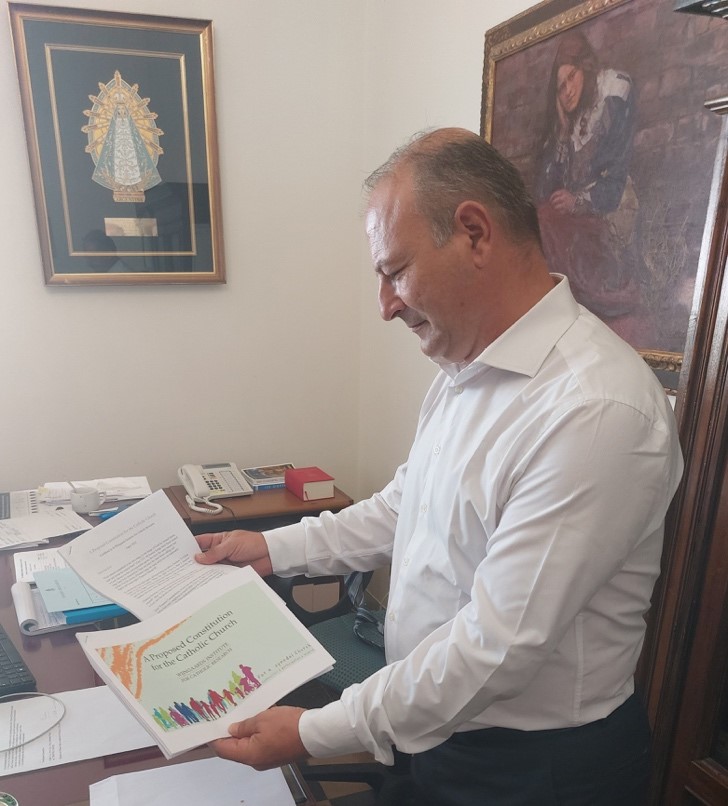
The constitution was submitted to both the national episcopal conferences of the countries our co-signatories come from, and to the General Secretariat of the Synod of Bishops. On August 26th, we met with and hand-delivered a copy to Thierry Bonaventura, the communications manager of the Synodal office in Rome (see photo below) who stressed that he, Sister Becquart and all the Synodal review committee would review the document in detail. We have also heard from a Bishop and member of the committee to decide which of the contributions from Western European Catholics will be submitted to the next phase of the synod, who said he will bring the constitution to the attention of his colleagues at that committee.
Key features and proposals
- Universal right to participate in church governance. All Catholics have a right to participate in the government of the church, as required both by their fundamental human rights (UDHR Art. 21) and by their baptismal rights.
- Non-discrimination. The selection of candidates for any church office, including sacramental ministry, must be done without discrimination based on race, gender, sex, sexual orientation, marital status, and economic or social condition.
- Subsidiarity and decentralisation. “Every church and decisional level in the church has an inalienable right and responsibility to determine both what decisions and actions falls within their competence, and what instead should be decided by delegation to, or accomplished better in cooperation with, the higher level. Conversely, each higher decisional level may only undertake those decisions and actions which the lower level freely delegates to them, and may not impose restrictions on the lower levels as to matters for decision or action without their consent” (Art. 34, see Art. 30).
- Leaders must be elected and representative of their constituents. Church officials exercising legislative or executive functions must be representative of the church community they serve. Accordingly, at each level of church governance, candidates to those ministries should be elected through direct or indirect universal suffrage.
- Consent. “Official church laws and doctrines passed by church representatives must reflect the consent of the churches to which they apply, and they are to be regarded as valid for as long as they enjoy that consent” (Art. 31).
- Separation of powers. The power of governance shall be divided between the legislative, executive, and judicial branches. Each branch is separated from the others, as well as from the so-called “sacramental power”, so that “A person or body holding one of those powers […] shall not concomitantly hold any of the others”. In other words: priests and bishops can only exercise the sacramental power, and they can no longer exercise any of the powers of governance (legislative, executive, or judicial), and much less do so exclusively.
- Leaders are legally required to take into account specialist knowledge whenever required by the matter at hand: “Should a decision require specialist knowledge – e.g. in biblical studies, theology, canon law, medicine, psychology, economics, sociology, etc. – church representatives and leaders, both individually or in groups, have a legal duty to seek and take into account relevant and independent expert advice” (Art. 68). “Membership of […] independent expert advisory bodies shall be selected via an open and transparent peer review process, whose criteria for selection must include relevant expertise, lack of conflict of interests, independence from church representatives and church leaders, and good standing within the relevant scientific community” (Art. 70).
- Leaders must be accountable. Church officials exercising legislative or executive power must only serve for a limited term of office, recommended to be five years. They should report at least annually on their actions, including their financial management.
- There must be full freedom to join and leave the Church. “By virtue of the universal freedom of conscience and religion, acquiring as well as relinquishing juridical membership of the Catholic Church entailing the acceptance of ecclesiastical rights and responsibilities must be the result of a free choice. (Art. 5).
Endorsements and comments from academic signatories
Prof. Mary McAleese, PhDs in law and in canon law, former Professor of criminal law and former President of Ireland, currently Professor of Children, Law and Religion, University of Glasgow, UK; Chancellor, Trinity College, Dublin, Ireland: “The proposed Constitution is the best idea the Catholic Church has had in centuries. It gives due respect to the God-given dignity of every member, puts Christ front and centre, loosens the strangling, controlling grip of imperialism and clericalism and lets the Church breathe again, love again, include again. We need this Constitution. It is our bridge to the future”.
Prof. Thomas Hieke, PhD, Professor of Old Testament, Faculty of Catholic Theology, Johannes Gutenberg University, Mainz, Germany: “This draft constitution is a magnificent prophetic vision of a Catholic Church as it should be – and as it could become. Indeed, this is a different Catholic Church, and this is what we urgently need. Only in this way can we leave behind the church of child abuse, homophobia, clericalism and the repressive exercise of power.”
Dr. Toni Bernet-Strahm, PhD in Catholic Systematic Theology, Theological author, former director of the Swiss Catholic overseas development non-profit RomeroHaus Lucerne, Switzerland; former Vice-president IRAS COTIS (Community for Interreligious Work in Switzerland): “Current canon law is blocking a synodal church that recognises the dignity of all the baptised. It is imperative to avoid a conflict within the Catholic Church between human rights and faith. The Church urgently needs a new church constitution that respects both. I’m delighted that the one coordinated by the Wijngaards Institute does exactly that.”
Prof. Daniel Bogner, PhD, Professor of Moral Theology, University of Fribourg, Switzerland: “So many voices today deplore the monarchist constitution of the church in canon law. Now there is a very courageous draft for a reform. What particularly impresses me is that this draft struggles to take up the spirit of the Gospel and the heritage of tradition on the one hand, but on the other hand to open up this heritage and to develop it further again and again. That is precisely what ‘being Catholic’ means.”
Dr. Raquel Mallavibarrena, PhD, Representative of We Are Church Spain, Madrid, Spain: “This document is necessary for the urgent reform of the Catholic Church, it is very complete, very well founded and responds to what Catholic reform groups around the world have been asking for many years. Hopefully it will serve to generate a profound debate in the Synod of Synodality so that the Catholic Church can be credible in the 21st century.”
Prof. Adrian Loretan, Professor of Canon Law & Law and Religion, Center of Comparative Constitutional Law and Religion (CCCLR), Faculty of Theology, University of Lucerne, Switzerland: “The Second Vatican Council (1962-65) fundamentally changed the ecclesiastical view towards the human person. In several places it forcefully affirmed the equal dignity of each human person and their inviolable personal freedom as a basis for a world with equal rights for all. It went as far as concluding that ‘with respect to the fundamental rights of the person, every type of discrimination, whether social or cultural, whether based on sex, race, color, social condition, language or religion, is to be overcome and eradicated as contrary to God’s intent’ (Gaudium et Spes, par. 29). This new constitution is a wonderful example of how such equality and freedom can be codified”.
Prof. Peter Nissen, Prof. of Theology (Emeritus), Radboud University, Netherlands: “This is a beautiful initiative and a wonderful document! I completely endorse its principles and I will gladly support it.”
Prof. Michael Lawler, Professor of Theology (Emeritus), Creighton University, Omaha NE, USA: “In these days, when the Catholic Church is engaged in rediscovering the ancient charism of synodality, the Proposed Constitution for the Catholic Church underscores ecclesial realities that are at the heart of synodality. All baptized Catholics, by the design of Christ and his Church, are equal and have the freedom and responsibility to pursue and enhance the mission of Christ and the Church. That mission is the service of all women and men and, in our grossly economically unbalanced world, as Jesus so often reminded us, particularly the poor. No one, no matter what authority she or he is thought to enjoy in the Church, is free to bar any of the baptized in Christ from actively propagating that mission.”
Rachel Joyce Marie O. Sanchez, PhD, Assistant Professor, Department of Theology, Ateneo de Manila, Philippines: “I am endorsing this proposal because I see it as a concrete step towards the church becoming a ‘discipleship of equals’ based on the inclusive table-fellowship we have seen Jesus realized during his ministry. I appreciate how theologians and academics have put their heads together to dialogue with church authorities in this constructive process. The proposed constitution reflects synodality both in terms of its content and in the process it’s taken to bring it up.”
Prof. Pedro Paulo A. Funari, PhD, Professor, Department of History, IFCH, Universidade Estadual de Campinas (Unicamp), Brazil: “The Proposed Constitution aims at living together (‘Convivencia‘, ‘Ubuntu‘), in collaboration, contrary to any exclusion, subordination or destruction: “The entire law is fulfilled in a single decree: ‘Love your neighbor as yourself’ (Galatians 5:14)”.
Fr. Max Stetter, Catholic priest and missionary, Pfarrer Initiative, Germany; Member of the International Church Reform Network (ICRN) Steering Committee: “Attention to the Second Vatican Council inspired Pope Francis to launch a courageous synodal process. But his goal of a ‘listening church‘ must find a structural implementation if it is not to remain just words. The Catholic Church has long seen itself as a ‘societas perfecta‘ (‘perfect society‘). It has long called for the world outside it to respect the fundamental human rights and the so-called ‘integral human development‘. The well-documented, extensive clerical abuse of power require that more attention be paid to implementing those standards inside the Catholic Church itself. We can no longer postpone replacing those structures in that church that contradict gospel values and thwart spiritual growth, with those which facilitate the discernment of the signs of the time and guarantee human and baptismal rights to the People of God. One could do much worse than starting with the Constitution for the Catholic Church proposed by the Wijngaards Institute for Catholic Research.”
Signatories
Contributing Authors
- Jane Anderson, PhD, honorary research fellow, University of Western Australia.
- Luca Badini Confalonieri, PhD, Director of Research, Wijngaards Institute for Catholic Research.
- Ann Marie B. Bahr, PhD, Emerita Professor of Religious Studies, School of American and Global Studies, South Dakota State University.
- Paul Collins, PhD, Australian historian, broadcaster and writer.
- John Esposito, PhD, Professor of Religion and International Affairs, and Professor of Islamic Studies at Georgetown University.
- Annette Esser, PhD, founder and chairwoman of the Scivias-Institut für Kunst und Spiritualität.
- Gerald Grudzen, PhD, President, Global Ministries University.
- Kathleen Maas Weigert, PhD, Professor in Sociology, Loyola University Chicago, USA.
- Mary McAleese, PhDs in law and in canon law, former Professor of criminal law and former President of Ireland, currently Professor of Children, Law and Religion, University of Glasgow, UK; Chancellor, Trinity College, Dublin, Ireland.
- Ángel Méndez Montoya, PhD, Professor, Department of Religious Sciences of the Universidad Iberoamericana Mexico City.
- Dietmar Mieth, PhD, Professor Emeritus of Theological Ethics and the Social Sciences, University of Tübingen, Germany.
- William Morris, bishop emeritus of the Catholic diocese of Toowoomba, Australia.
- Stanisław Obirek, PhD, Professor of Humanities, University of Warsaw, Poland.
- Thomas O’Loughlin, PhD, Professor of Early Christianity, Department of Theology and Religious Studies, School of Humanities, University of Nottingham, UK.
- John O’Loughlin Kennedy, D.Sc., Economist (retired), Studied at UCD and as a Fulbrighter at UCLA. Author of “The Curia is the Pope”. Co-founder with his wife, Kay, of Concern Worldwide.
- Joseph Pathrapankal, PhD, Director, Anugraha Renewal Centre, Kottayam, Kerala, India (please note: sadly, Fr. Parhrapankal died on 27 February 2022, and so he did not contribute to the final version of the constitution).
- Gunter Prüller-Jagenteufel, PhD, Associate Professor of Theological Ethics, Faculty of Catholic Theology, University of Vienna (Austria).
- Susan Roll, PhD, Associate Professor (Emerita), Faculty of Theology, Saint Paul University, Ottawa, Canada.
- Patricia Rumsey, PhD, Honorary Associate Professor, University of Nottingham; abbess of the monastic community in Arkley, North London; member of the Council of the Poor Clare Federation of Great Britain.
- Todd Salzman, PhD, Amelia and Emil Graff Professor of Catholic Theology, Creighton University, Omaha, Nebraska, USA.
- David Stronck, PhD, Professor (Emeritus), Department of Teacher Education, California State University, USA.
- Luiz Carlos Susin, OFM Cap, PhD, Professor at the Pontifical Catholic University of Rio Grande do Sul and at the Escola Superior de Teologia e Espiritualidade Franciscana, Porto Alegre.
- Leonard Swidler, PhD, Professor Emeritus of ‘Catholic Thought & Interreligious Dialogue’, Temple University; Founder/President, Interreligious, Intercultural, International Dialogue Institute; Founder/President of the ‘Association for the Rights of Catholics in the Church’, Philadelphia, USA;
- Sam J. Thomas, PhD, Professor Emeritus, Department of History, Michigan State University, East Lansing, Michigan, USA.
- John Wijngaards, PhD, Professor Sacred Scripture (Emeritus), Missionary Institute London, UK.
- Hans-Georg Ziebertz, PhD, Professor for Practical Theology, University of Würzburg, Germany.
Co-signatories
- Antonio Autiero, STD, emeritus Professor of Moral Theology at the University of Münster, Germany.
- Toni Bernet-Strahm, PhD in Catholic systematic theology, former director of RomeroHaus Lucerne, Switzerland.
- Daniel Bogner, PhD, Professor of Moral Theology, University of Fribourg, Switzerland.
- Agnes Brazal, PhD, Professor of Religious Studies, Department of Theology and Religious Education, De la Salle University, Manila, Philippines.
- Denise Couture, PhD, Professor of Theology (Emeritus), Faculté des arts et des sciences – Institut d’études religieuses, Université de Montréal, Canada.
- Sabine Demel, PhD, Professor of Canon Law, University of Regensburg, Germany.
- Margit Eckholt, PhD, Professor of Dogmatic and Fundamental Theology, Institut für Katholische Theologie, Universität Osnabrück, Germany.
- Julia Enxing, PhD, Professor of Systematic Theology, Institute of Catholic Theology, TU Dresden, Germany.
- Pedro Paulo A. Funari, PhD, Professor, Department of History, IFCH, Universidade Estadual de Campinas (Unicamp), Brazil.
- Hille Haker, PhD, Richard McCormick S.J. Endowed Chair of Catholic Moral Theology, Department of Theology, Loyola University Chicago, USA.
- John F. Haught, PhD, Distinguished Research Professor, Department of Theology, Georgetown University, Washington DC, USA.
- Thomas Hieke, PhD, Professor of Old Testament, Faculty of Catholic Theology, Johannes Gutenberg University Mainz, Germany.
- Liza B Lamis, DMin, Executive Secretary, International Fellowship of the Least Coin.
- Armando Lampe, PhDs in Catholic Theology and Political Science, Catholic theologian and former education minister of Aruba (2017-2021).
- Michael Lawler, PhD, Creighton University, Omaha NE, USA.
- Michael Leahy, STL, PhD in Educational and Political Philosophy, former priest of the Catholic Archdiocese of Melbourne, Australia.
- Adrian Loretan, PhD, Professor of Canon Law & Law and Religion, Center of Comparative Constitutional Law and Religion (CCCLR), Faculty of Theology, University of Lucerne, Switzerland.
- Raquel Mallavibarrena, PhD, representative of We are Church – Spain, Madrid, Spain.
- Kristine C. Meneses, PhD, Assistant Professor of Theology, Institute of Religion, University of Santo Tomas, Manila, Philippines.
- Peter Nissen, PhD, Prof. of Theology (Emeritus), Radboud University, Netherlands.
- Francisco Orofino, PhD in Biblical Theology, Professor of Biblical Studies at the Instituto Pablo VI, Nova Iguaçu, Brazil; Advisor to the Centro Ecumênico de Estudos Bíblicos (CEBI), São Leopoldo, Brazil.
- Richard Penaskovic, PhD, emeritus professor of religious studies, Auburn University.
- Daniel Franklin Pilario CM, PhD, Professor of Theology and Dean of St. Vincent School of Theology, Adamson University, Manila, Philippines.
- Stephanie Ann Y. Puen, PhD, Assistant Professor, Department of Theology, Ateneo de Manila University, Philippines.
- Philippa Rath OSB, theologian, historian and political scientist, Benedictine nun at the Abbey of St. Hildegard in Rüdesheim-Eibingen, elected member of the Zentralkomitee der deutschen Katholiken (ZdK, “Central Committee of German Catholics”); delegate of the Deutsche Ordensobernkonferenz (“German Conference of Religious Superiors”) to the Forum “Women in Services and Offices of the Church” of the Synodale Weg (“Synodal Way”).
- Thomas Ruster, PhD, Professor of Catholic Systematic Theology, Department of Catholic Theology, Technische Universität Dortmund (TU Dortmund), Germany.
- Virginia M. Ryan, PhD, Professor of Theology (Emeritus), Holy Cross College, USA.
- Rachel Joyce Marie O. Sanchez, PhD, Assistant Professor, Department of Theology, Ateneo de Manila, Philippines.
- Max Stetter, Catholic priest and missionary, Pfarrer Initiative, Germany; Member of the International Church Reform Network (ICRN) Steering Committee.
- José María Vigil, PhD, Prof. of Theology, previously at the Centro Regional de Estudios Teológicos de Aragón, of the Pontifical University of Salamanca, Spain; and the Central American University, Managua, Nicaragua; coordinator of the Latin-American Theological Commission of the Ecumenical Association of Third World Theologians.
- Werner Wolbert, PhD, Professor Emeritus of Catholic Theology, University of Salzburg, Germany.
Ecumenical Co-signatories
- Maria Aparecida de Andreade Almeida, PhD in Biblical Studies, Post-Doctorate in History and Archeology (2014/2017), Universidade Estadual de Campinas (Unicamp), Brazil; Pastor, United Presbyterian Church.
- Erhard S. Gerstenberger, PhD, Professor of Old Testament (Emeritus), Philipps-Universität Marburg, Germany.
- Francisco Leite, PhD in Philology and Portuguese Language, University of São Paulo; Master in Science of Religion, Methodist University of São Paulo; BA in Theology, Mackenzie Presbyterian University; Pastor, United Presbyterian Church.
- Betty Ruth Lozano Lerma, PhD, Research Director of the Fundación Universitaria Seminario Teológico Bautista Internacional (Unibautista), Santiago de Cali, Colombia.
- Susanne Scholz, PhD, Professor of Old Testament, Perkins School of Theology, Southern Methodist University, Dallas, Texas, USA.
Organisations that endorse this Constitution
- International Church Reform Network (https://icrn.info/).
- We Are Church International (https://www.we-are-church.org/413/).
- Scottish Laity Network (http://scottishlaitynetwork.org.uk/).
- Root & Branch (https://www.rootandbranchsynod.org/).